

One Common Cooking Ingredient Can Eliminate Fast-Growing Spurge Weed From Your Garden

If you leave your garden or backyard walkways unattended for several weeks, you might come back to an explosion of aggressive weeds. One fast-growing weed that is a particular pain to deal with is spurge weed. Also commonly called milkweed, this sun-loving plant with tiny leaves and a milky sap grows low to the ground. It might seem innocent, but don't let it fool you; its seeds can germinate rapidly, and before you know it, the plants you actually want are being suffocated with a mat of spurge. Your reaction might be to get an easy fix, like weed killer, but there's a more natural alternative for getting rid of weeds sitting in your kitchen pantry.
Vinegar not only works to clean your kitchen, but also to clean up the garden. Conventional weed killers are often made from some rather harsh chemicals that may negatively impact the soil, insects, birds, and even the plants you want to keep healthy. While weed killer is very effective, it is often too effective, killing or harming more in the garden than you intended.
Vinegar, however, is a safe and cheap alternative to keep spurge weeds under control. While it may have a negative impact on some insects, it is generally a lot safer than weed killer for most things in your garden. This kitchen staple works for killing weeds due to the presence of acetic acid, which works to dry out and kill plant cells.
How to use vinegar to kill spurge weed
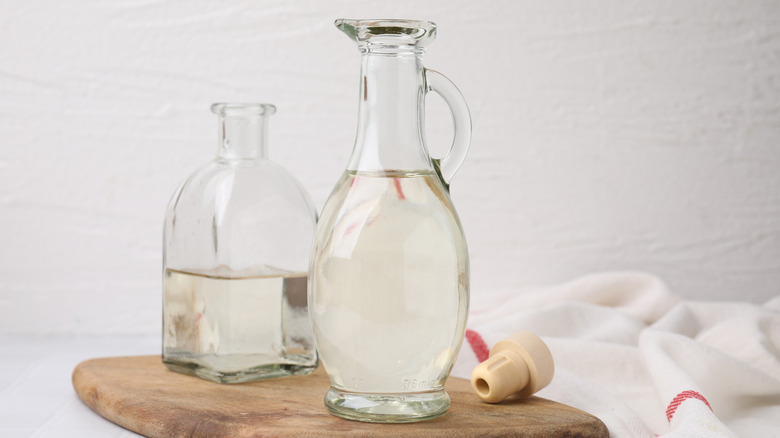
For this weed killing method, don't use your balsamic vinegar that gets spritzed on salads, but rather a household white vinegar that would be used for cleaning. This option is also a lot more economical than the nicer glass bottles of culinary vinegar. White cleaning vinegar contains about 5 percent acetic acid, but if you want something more powerful, a horticultural vinegar contains upwards of 20 to 30 percent.
The most effective way to kill spurge weeds is by first weeding by hand as much as you can. Then, the vinegar can be poured on where the weeds were growing, ideally coating any remaining stems and roots. If you've weeded a large area or sidewalk cracks, vinegar can be applied with a spray bottle. Of course, be mindful that you are not spraying other plants that you would like to keep alive and healthy. It might be tempting to supercharge the vinegar with baking soda, but this shouldn't be used in the garden because it can kill other plants too easily.
It might be necessary to repeat this process after a few days if you notice the spurge starts recovering. Or, if it has rained and you've been watering the garden, it will be necessary to do another spray. Try to get to the spurge weed as soon as you see it — the more it matures, the harder it is to get rid of. Regular maintenance is a good idea, as spurge does drop a lot of seeds, so it may take a few cycles before you notice an impact. You'll be pleased to know that vinegar is also useful in the destruction of other common weeds in your garden, such as crabgrass and dandelions.