

The Stovetop Cooking Habit Boomers Love That Millennials Grew Up To Hate
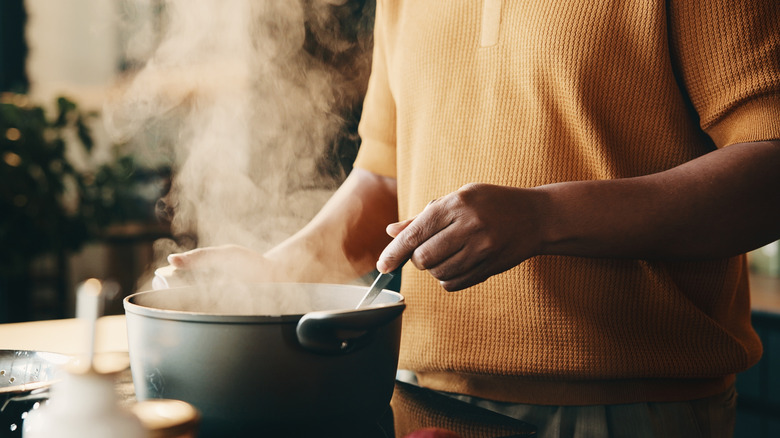
Ask a millennial what cooking method they think is unappealing and outdated, and there's a decent chance their answer will be boiling — and their boomer parents may object. And there are some reasons behind why each of these generations holds these views. As a millennial, I definitely perceive boiling as a pretty low-flavor cooking method. Do it to vegetables, and they come out, well, not tasting like much and in desperate need of seasoning. Eggs might come out even worse, with some millennials unfondly recalling boomer parents boiling them into oblivion, until the yolks came out green-gray. Meat may be the worst-case scenario, as boiling renders it not just flavorless but impossibly tough.
There are some historic reasons why boomers are so enamored with boiling, though. It used to be a reliable way to eliminate pathogens, for one. When boomers were growing up, food safety in the supply chain was a work in progress (for example, food recalls didn't even start until the '70s), so this was something you had to take into your own hands. Plus, dumping everything into one pot of boiling water was seen as a shortcut, equivalent to the modern-day sheet-pan meal. Cookbooks that boomers' parents might have used also suggested boiling green beans for hours. It wasn't until the '70s that chefs like Paul Bocuse suggested reining that in. Then, in the '80s, roasting vegetables truly got a foothold (giving your vegetables more flavor courtesy of the Maillard reaction), with the oven previously seen as something used mostly for baking.
More problems, and how to make boiling better
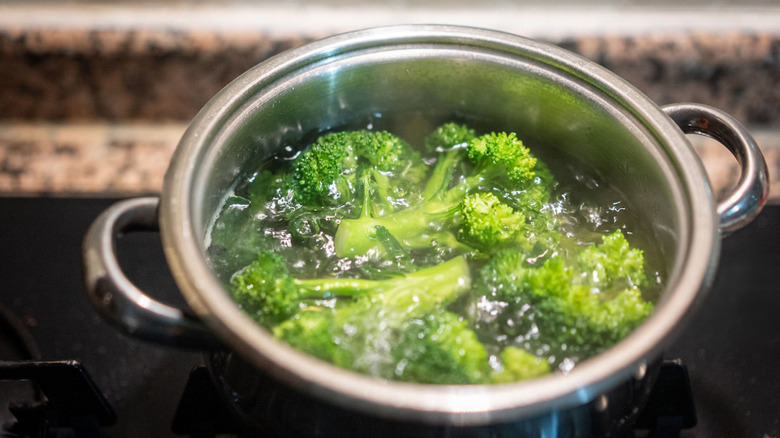
Not to be all millennial about it, but there are even more downsides to boiling. Beyond the flavor issue, it can also sap nutrients from vegetables, as they leach out into the boiling water and get tossed away. For example, boiled broccoli and spinach lose around half their folate (a B vitamin that keeps your cells healthy), and boiling broccoli will cull over a third of its vitamin C.
Of course, boiling has its place, though. There are some obvious cases like pasta where it's pretty much mandatory. The key is to salt your water well. A tablespoon of table salt (a bit more for kosher salt) for each 4 quarts of water is good, and health-conscious readers need not worry, as only ¼ teaspoon of that actually absorbs into the pasta. Take note that opinions vary somewhat on the "right" amount of salt. If you find yourself boiling vegetables, this is some advice worth recycling — salt your water here too, somewhat more than pasta water (up to 2 tablespoons per quart) to help them retain some flavor.
You can also blanch your vegetables, where you boil them briefly then put them into an ice bath. Sure, you'll probably then go on to saute or stir-fry them, but it actually helps them keep their flavor, color and texture. It's also a good method to help vegetables freeze well, without ruining their texture. So, blanching just goes to show that even if boiling alone may not always result in tasty veggies, a little bit of it can be a good thing.