

Merlot Vs Malbec — What's The Actual Difference?
Merlot and malbec have quite a bit in common, despite the former thriving in France and the latter in Argentina. As it turns out, the two red wines share Bordeaux lineage, more specifically, a parent: the old French Magdeleine Noire des Charentes grape variety. Naturally, that shared background also translates into the glass.
Both merlot and malbec produce rich, medium-to-full-bodied red wines, with plenty of ripe fruit notes. Expect something along the lines of plum, blackberry, and black cherry. They also have their fair share of tannins. If you don't know what exactly tannins are and how they impact your wine, they're polyphenolic compounds that lead to a dry, puckering sensation in your mouth.
In addition, both varieties can produce wines with a smooth, rounded texture, especially when the grapes are fully ripe. On top of that, each responds well to oak aging. It makes them more complex and introduces hints of vanilla, cocoa, and spice. Still, with all these similarities, each variety has its own distinct character. So, what is it that really sets merlot and malbec apart?
Merlot can go from fresh and fruity to rich and velvety
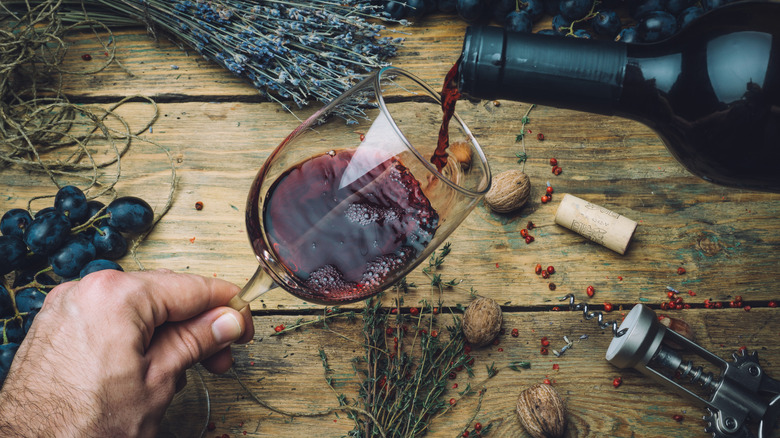
Now, merlot took somewhat of a hit after the release of the 2004 comedy-drama "Sideways" (a phenomenon called "The Sideways Effect"). However, that still didn't stop it from remaining one of the world's most popular wines. The reason? Merlot is remarkably versatile. Style-wise, it can range from soft and fruity to full-bodied and complex. In the glass, merlot usually appears deep ruby-red or garnet depending on the region and the winemaking style. Meanwhile, younger merlots tend to show subtle purple tones.
Closely associated with Bordeaux's Right Bank, particularly Saint-Émilion and Pomerol, merlot is an undisputed blending champion. Due to its smoother, softer tannins, it can beautifully balance more robust, structured wines featuring cabernet sauvignon or syrah. On the nose, cool-climate merlot often comes with cherry and raspberry notes. It can even develop leafy or herbal notes. Warmer climates, in turn, bring out those darker blackberry and black cherry aromas, while oak aging can also introduce some spicy, woodsy, and tobacco hints. On the palate, merlot is luscious and boasts fresh, medium acidity. Its alcohol content typically ranges from 13% to 15% ABV.
Merlot pairs wonderfully with beef tenderloin, short ribs, lamb, and duck. Its earthy side also makes it a great match for mushroom risotto and truffle pasta. For a simpler option, try pairing it with pizza, chicken, or aged cheeses. That said, merlot also has a place in the kitchen. It's actually one of the absolute best types of red wine to use for pot roast.
Malbec may be French, but Argentina made it famous

While merlot is more about subtlety, malbec instead brings more depth and intensity. It produces deeply colored, fuller-bodied red wines with tannins that are more pronounced than those of its half-sibling. This is largely due to the grape variety's smaller, thicker skins. Malbec's flavor profile is mostly dominated by dark fruit. However, floral notes, such as violet, are also among its signature characteristics. In certain cases these wines can also exhibit nuances of sweet spice, leather, clove, as well as mocha undertones, particularly when aged in oak barrels. In fact, a year of oak aging can even give malbec a distinctive blueberry aroma.
Malbec was once widely planted across France and a staple of Bordeaux blends. It was largely abandoned after a devastating 1956 frost wiped out three-quarters of the vineyards growing it. Although still produced in the Cahors region, malbec found a second home in Argentina's Mendoza region, where it is now the nation's leading red variety. To give it a try, check out the best bottles of Argentine malbec under $25.
The wines usually have medium acidity, around 13.5% to 15% ABV, and boast a relatively dry, smoky finish. Because of this, they pair well with leaner red meats and dark-meat poultry. Earthy vegetables and mushrooms are also a great match. Other classic pairings include grilled steak and barbecue, along with rich, hearty stews like beef bourguignon or Gascon cassoulet. Blue (or any other type of funky cheese) is yet another excellent pairing option.