

2 Best Lean Steak Cuts To Try If Ribeye Is Too Fatty For Your Taste
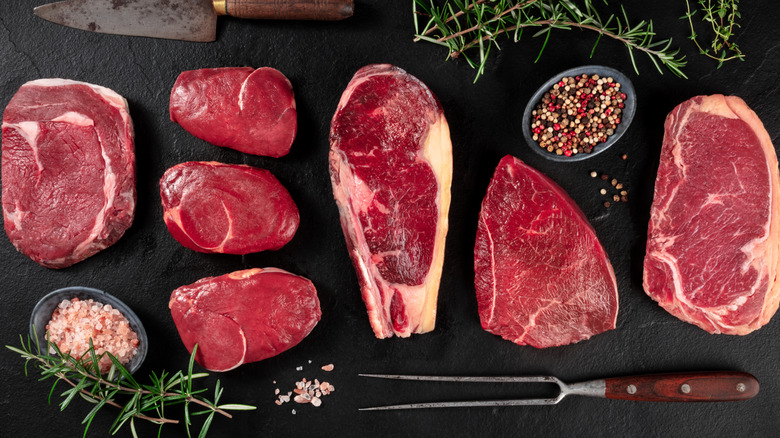
The classic ribeye is an icon of the red meat genre for a lot of carnivores. The rich slab is prized for its robust marbling, which renders as it cooks. But that supreme richness isn't for everyone, and there are plenty of other cuts that offer a similarly substantial bite without quite as much intramuscular fat. The good old New York strip and the somewhat lesser-known Denver steak retain some of the ribeye's qualities, just with less fat.
Although ribeyes and New York strips come from neighboring areas of the cow's back, they have notably different fat contents. Like the ribeye, a strip has visible marbling, just not quite as much as the former cut. That can make the strip taste beefier to a lot of people, compared with the silken, buttery notes that many detect — and even detest! — in the ribeye. That reduced fat also means a New York strip may be less tender than a ribeye prepared the exact same way. But there are plenty of methods for making an excellent New York strip in its own right.
The Denver cut from the animal's shoulder also has enough marbling to keep it juicy and flavorful. Its association with the chuck, often thought of as tough, may also help keep the Denver steak somewhat more affordable than more famously fancy cuts. And, like the strip, it has a concentrated beefy flavor without the ribeye's unctuousness. Prepared just right, nobody will dare call these cuts mere ribeye replacements.
How to keep strip and Denver steaks juicy and tender
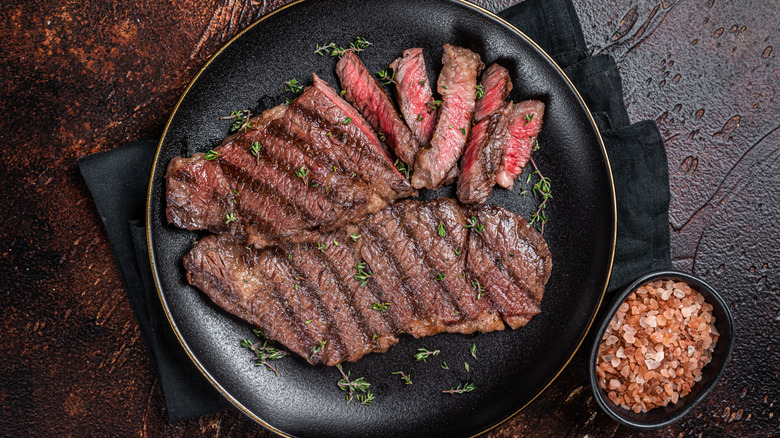
The relative leanness that one might seek from a New York strip or a Denver steak makes both a little more vulnerable to overcooking than a fattier option, so you'll want to keep a meat thermometer handy and know your temperature targets for rare, medium, and well-done steak before you even start cooking. Fortunately, many people enjoy both strips and Denvers at a medium-rare 130 degrees Fahrenheit, so there's only one number to keep in mind.
Strips and Denvers can reach that temperature after a couple of shakes of salt and pepper and a few minutes on each side over high heat in an oiled pan on the stovetop. How few minutes will depend on thickness, but it's a good idea to start checking the temperature about two minutes after your first flip. They'll probably need more time, but while you can always cook a steak a little longer, science has yet to find a way to bring an overdone one back to palatability. You might even want to consider pulling your steaks at 125 degrees to account for carryover cooking that can take them past your desired doneness. You'll surely want to tinker with an extra seasoning here and there, but the right temperature offers the best chance of a juicy strip or Denver steak.