

The Popular Steak Cut You Should Absolutely Never Order Rare

A person's steak temperature preferences can sometimes get them into trouble. Rare steak devotees who declare their desired doneness before they've even perused the menu might even be surprised to learn that what's good for a tenderloin just isn't suitable for the more affordable but still plenty flavorful tri-tip steak. Tri-tip needs to reach a higher internal temperature to achieve anything close to the tender, yielding texture diners seek. Order a tri-tip rare, and you're asking for a chewy jaw workout. But the good news for those on team rare who might be loath to change their order is that they don't need to stray too far away from their reliable standard for a tip-top tri-tip. Just ask for medium-rare to medium to receive the tastiest (and still plenty pink) steak.
Sourced from the bottom sirloin, lean tri-tip steaks are full of bovine flavor but tough prior to any culinary intervention. True to their name, juicy tenderloins actually start out, you know, tender enough for just the quick kiss of heat that can cook a steak rare. But tri-tips need a bit more time for their fibers to loosen up to anywhere near that consistency. So, order your tri-tip medium-rare to medium, which will hover at around 130 to 135 degrees Fahrenheit back in the restaurant's kitchen and leave you with a much tastier plate.
More ordering tips and other steaks that should turn up the heat
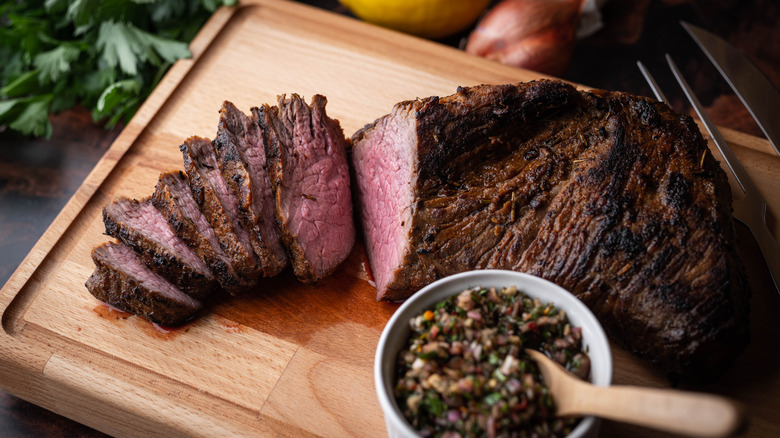
Ordering your tri-tip steak to an optimal medium-rare to medium at a restaurant should take nothing more than that stated request. You can also cite the precise temperature range — which, again, will be around 130 to 135 degrees Fahrenheit — if you want to be really particular and maybe even catch a little side-eye from your server. Commit specific steak doneness numbers to memory, and you'll never have to wonder what someone else's ideas of rare, medium, and well done are ever again, however pedantic you might seem at the table. And, should you simply decide to pivot instead, remember that tri-tip steaks aren't the only variety that might require a rare departure, either.
The ever-popular ribeye is another cut that just performs better above a rare doneness. But red meat lovers still needn't fear; just like the tri-tip, "above" is more of a hop than a leap in this case. Ribeye, too, is best prepared to at least medium rare to give it enough time over the fire for its prized, marbled meat to melt into the flesh for maximum flavor and juiciness. You just can't create that same effect with the faster cooking that gets a steak to rare. This is part of what makes the ribeye perfect for grilling. A similar principle applies to your nicely marbled New York strips, and you should certainly always ask your server what temperature the kitchen recommends to actually taste your steak the way the house intended.