

Is Japanese Wasabi Different From American Wasabi?
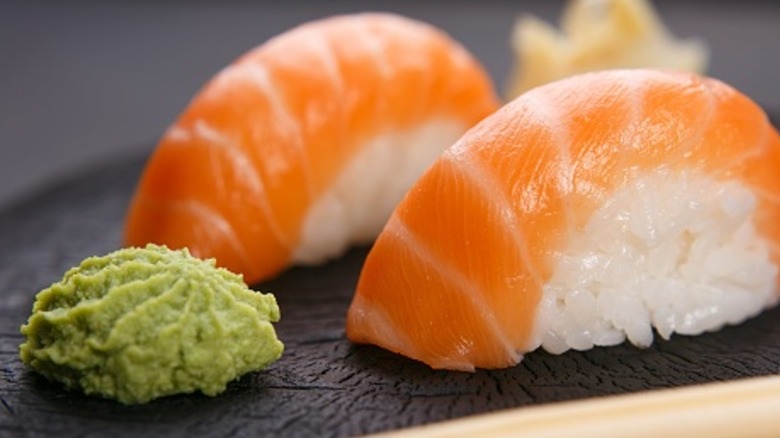
If you've ever ordered sushi at a restaurant in the U.S. and wondered whether or not that little green pile of paste on your plate is authentic Japanese wasabi, you've every right to question it. As has been speculated on Reddit and reported by American media for years, the vast majority of wasabi served in the U.S. is not the traditional stuff at all. It is a mixture of horseradish and mustard infused with a dose of green food coloring. By contrast, real Japanese wasabi, also known as Japanese horseradish, is not a dyed mixture at all, but finely grated Wasabia japonica or Eutrema japonicum, a plant with its own naturally spicy flavor and vibrant green hue
The American concoction is markedly different from traditional Japanese wasabi, and the extent of this dissimilarity may surprise you. While a lot of people like the overly spicy taste of this faux wasabi (which means it isn't among the common imitation foods you should avoid), the fact remains that American wasabi is often presented as the real thing, which can be off-putting indeed. Despite fake wasabi being found in so many restaurants, it is still possible to find the authentic Japanese variety, you just may not know what to look for.
The key difference between American wasabi and Japanese wasabi is flavor
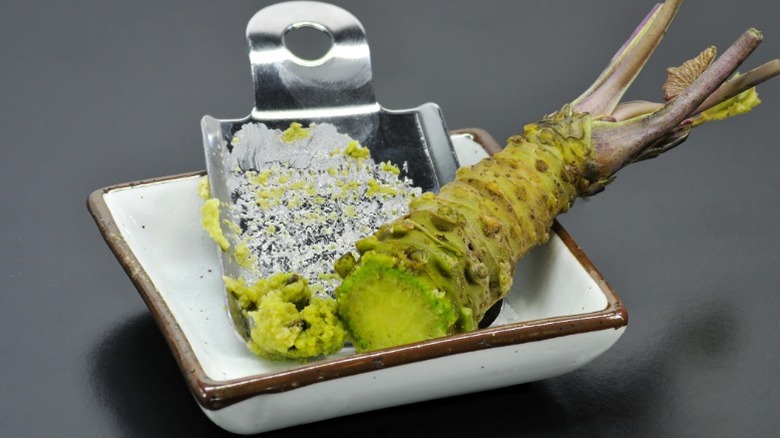
There are some key distinctions in taste, color, and texture between Japanese wasabi and the American variety. The American version is quite spicy and a tiny bit goes a long way. Depending on the amount of food dye that's used, it may also be a bright, unnatural-looking green hue. In some versions, cornstarch is also used, among other ingredients.
Meanwhile, Japanese wasabi is much simpler and leans on the plant itself for flavor and color. It's more muted in hue, generally a light, gray-green, rather than a bright, artificial tone. Plus, since one of the key differences between horseradish and wasabi is that the latter is stronger, the Japanese variety has a milder, sweeter, and earthier heat that quickly fades after eating it. It may also have a floral aftertaste.
One of the big things to note about Japanese wasabi is that it can vary in flavor depending on what parts of the plants are used. Japanese wasabi is most commonly grated from the root of the plant, or rhizome, though occasionally some chefs will use parts of the stem for a more flavorful variation in the resulting paste. Grate technique also matters, as it will determine how fine of a paste the wasabi turns out to be.
Authentic Japanese wasabi is a lot rarer than American wasabi
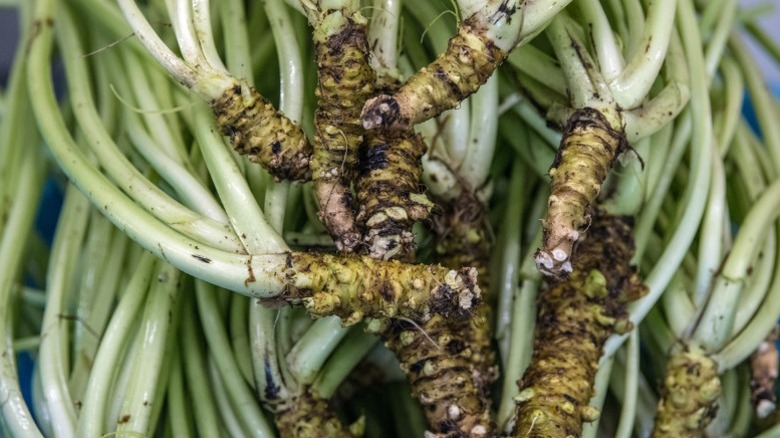
Japanese wasabi has become a rarity, even in Japan. That's thanks to the fact that this plant is difficult to grow. According to the New York Times, the challenges in its cultivation are being exacerbated by climate change and cultural upheavals in Japan. As such, real Japanese wasabi is actually pretty expensive, making it a luxury item. The rhizomes start around $40 and can quickly exceed $100, depending on size.
Ready grated Japanese wasabi also isn't generally available commercially because it is highly perishable. So, if you are lucky enough to come across it in a restaurant, that likely means it was grated and prepared right there on the premises for maximum freshness. And, since Japanese wasabi is so relatively rare, there's a good chance that the restaurant serving it will make it clear to customers that it's on the menu.