

The Rare Type Of Watermelon That's Only Grown In Japan
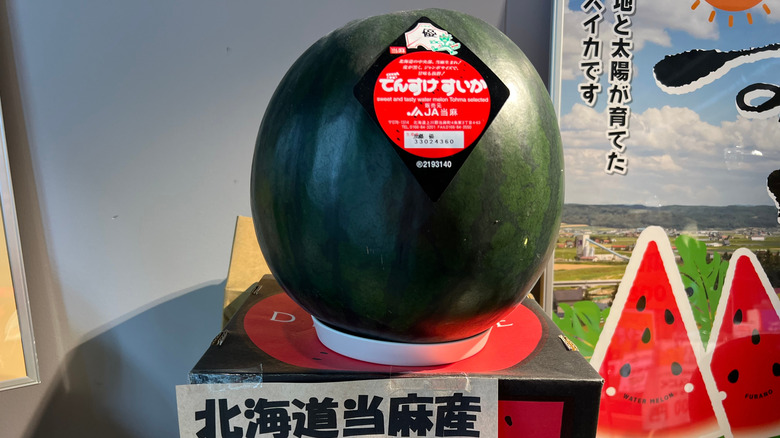
Watermelon is a great way to cool down when the heat kicks in. At about 92% water, it's no wonder it bears that name. According to the U.S. Department of Agriculture, watermelon is one of Americans' most beloved summer fruits, and their favorite type of melon. But the U.S. isn't the only country that loves this giant berry. China is the country that produces the most watermelons, but Japan is home to one of the world's most prized varieties: the Densuke.
Like the Black Diamond watermelon, one of the cultivar's defining features is its thick, dark green rind that is commonly mistaken for black. The Densuke is grown exclusively in Tohma, a tiny town located on Japan's northern island of Hokkaido. The site is ideal for its development, as it's covered in mineral-rich volcanic soil. The variety is one of those rare foods you should try at least once in your life. It's incredibly juicy, almost seedless, and very sweet, with roughly 13 grams of sugar per 100 grams of fruit. It's also among the world's most expensive fruits, typically selling for a few hundred dollars. That said, a record-breaking specimen fetched around $6,000 at auction in 2008.
The real reason Densuke watermelons are so rare
Densuke is a hybrid, a cross between several traditional Japanese watermelon varieties. First introduced in the early 1980s, it didn't take too long before its popularity grew. By the end of the decade, Densuke had become trademarked. Today, only Densuke watermelons that are grown locally and meet strict quality standards can carry the name, meaning watermelons produced outside Tohma cannot legally be sold as Densuke. On top of that, each watermelon comes in a protective box with a certificate of origin.
Another reason Densuke is so rare is its limited production. Growers produce and harvest only about 10,000 Densuke watermelons each year. This significantly increases their value. Due to their rarity and price, they're considered symbols of status in their place of origin and they're also frequently given as a prestigious gift. Densuke watermelons can also be found in the U.S. and Europe, where they appear in specialty grocery stores from time to time. Moreover, you can find Densuke seeds if you want to try your hand at growing these sweet beauties yourself, but they won't be real Densukes if they're grown outside their designated geography.