

Onion Fertilizers Could Be Sabotaging Your Bulb's Shelf Life
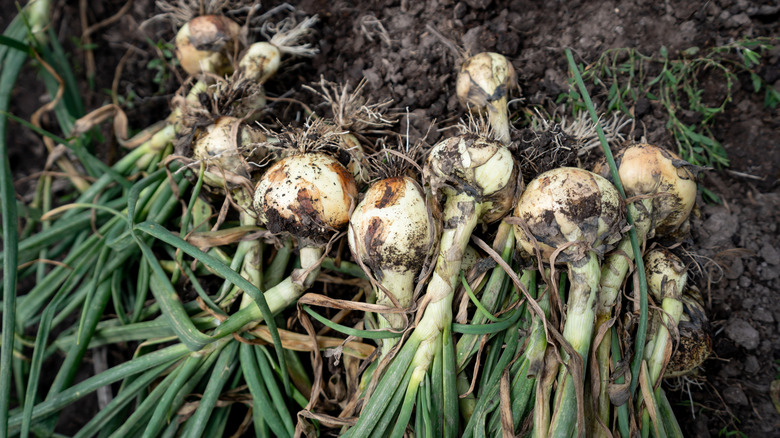
If you're a passionate gardener, chances are you've already planted onions in your backyard. Whether you decide to grow them from seeds, transplants, or sets (small starter bulbs produced the previous year), they're some of the most beginner-friendly and low-maintenance veggies out there. However, storing them can be quite challenging, as they need to be properly cured in a shady, warm, dry, and aerated spot after harvest. The process usually lasts for up to four weeks. Julia Child suggested storing onions in pantyhose to keep them safe from moisture and spoilage. Yet, even the cleverest storage hacks in the world can't make up for overfertilizing, which can significantly shorten your bulbs' shelf life.
In an exclusive conversation with Chowhound, Shaina Bronstein, area sales manager at Vitalis Organic Seeds, part of the Enza Zaden vegetable breeding firm, and a member of the National Garden Bureau, pointed out that excessive fertilizer usage could reduce an onion's shelf life. "Onion plants that are overfertilized with nitrogen will put too much energy into producing leaves and will not dry down properly to allow for long storage," Bronstein noted.
Overfertilizing can lead to bulbs with thick necks, which greatly affects their storage potential. This is because these necks retain water. As a result, they're more prone to rot and pest damage. They are also more likely to sprout prematurely.
Bronstein recommends fertilizing during the early stages of growth. Specifically, experts suggest using nitrogen and potassium for early development, sulfur for plant vigor, and phosphorus for roots and bulbs. "However, plants should not be given additional nitrogen fertilizer once they start to bulb out (generally around the summer solstice)," she added.
The best storage practices start in the garden
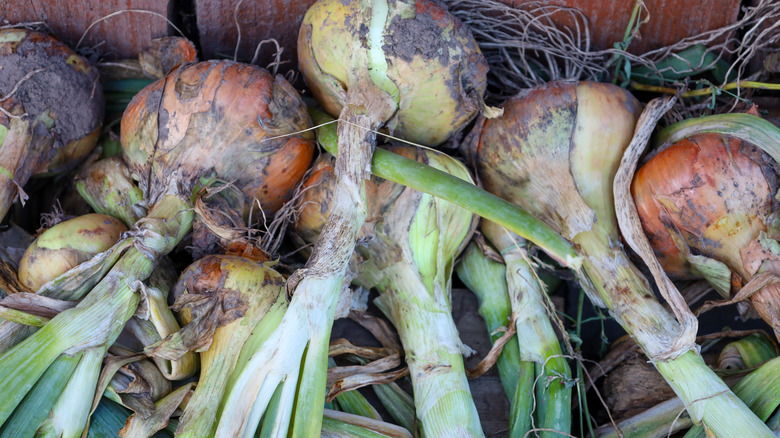
Nitrogen promotes vegetative growth. Hence, it becomes less useful later in the growing season since the plant should prioritize bulb development and ripening. Continued nitrogen applications can not only delay maturity, but also shorten the bulbs' storage life. That said, fertilizer management is only the beginning. There are several other growing and harvesting practices that could also help produce longer-lasting bulbs, like growing onion varieties adapted to your local climate. For example, long-day varieties, which typically need more than 14 hours of sunlight to grow properly, are known for their excellent storage life.
Shaina Bronstein also highlighted the importance of spacing. "Plants should be spaced at 4-6 inches — a too wide spacing does not allow for competition between plants, so bulbs may get excessively large or 'blow-out,'" she stressed. "If using transplants or sets, ensure they are not planted too deep, as this may also cause thicker necks that do not store as well." That's why you shouldn't toss egg cartons. Use them in your vegetable garden for easy planting, instead.
She also said that the bulbs should be harvested once their tops have fallen over. This is the best way to know if your garden onions are ready to harvest. However, if you live in an area with heavy rainfall during harvest, make sure the onion tops are still green when you pick them. "Onions (with the tops still on) can then be placed in a well-ventilated area with plenty of airflow to allow for drying before storage," Bronstein continued. At the same time, leaving mature bulbs outdoors too long can increase the risk of storage decay.