

Why You Don't Really See This Old-School Beer Brand On Shelves Anymore
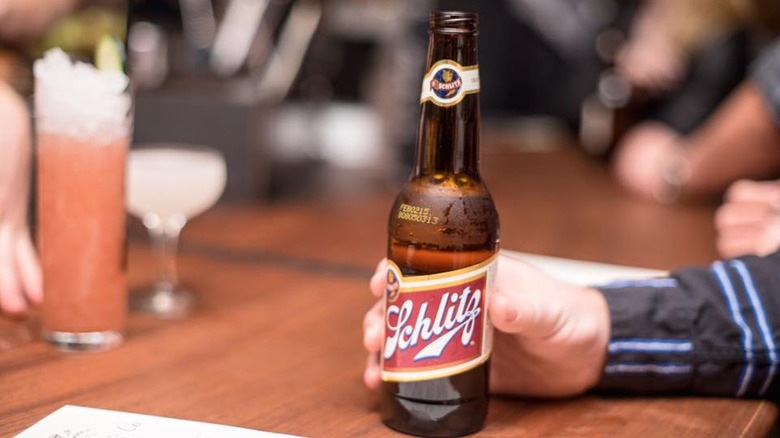
There are many beer drinkers who hold award-winning old-school brands in high esteem. Some classic beers that were staples of the 20th century can be difficult to find. Some of these iconic brands still exist, however, including one formerly famous beer that you can still purchase, although it's only available in select regions: Schlitz.
Schlitz beer was founded in Milwaukee, Wisconsin, in 1849 by August Krug, then taken over by his bookkeeper Joseph Schlitz in 1856 to become Schlitz Brewing Co. Currently, Schlitz is sold mainly in the Midwest, including cities like Milwaukee, Chicago, Minneapolis, and in select Southern states like Florida. However, Schlitz was formerly the largest, most well-respected beer brand in the country well into the mid-1900s. Unfortunately, the company experienced a downfall in the 1970s after changing the beer's recipe to cut costs, which severely damaged its reputation. The way one commenter on Reddit described it, "My dad would wax nostalgic about the fall of Schlitz brewing in pursuit of profit. Before they turned it into alcoholic corn syrup with a chemical aftertaste in the 70s, supposedly it was the best tasting beer."
The newly formulated Schlitz became considered a cheap beer, and given the drinkability of cheap beer brands, this was quite a blow. The company was eventually purchased by Pabst in 1999. Seeing potential for the original Schlitz beer among nostalgic, loyal fans, Pabst resurrected the classic Schlitz recipe in 2008. It was a big hit, though the beer is sold in a smaller, regional market in which the brand has historical roots.
The lager formula that led to Schlitz's demise
Schlitz beer is an American adjunct lager, commonly made in the 19th century by large-scale iconic breweries located in Milwaukee, Wisconsin, like Pabst and Miller. Another adjunct lager which was produced by Schlitz Brewing Company is an iconic all-American beer you probably forgot existed: Old Milwaukee. This type of beer is light bodied and pale, and has a moderate alcohol content. It's typically made with a focus on mass-production, often utilizing cereal grains, such as rice and corn, to save money.
Fittingly, it was a combination of high demand and desire for profit that led Schlitz to cut costs by shortening the fermentation time, which made the beer go flat, and incorporating corn syrup. Customers weren't pleased. Schlitz then added seaweed to make the beer fizzy again, but this produced floating solids. Continuing to sell beer with the new formula instead of pulling it from the shelves is considered the Schlitz Mistake and led to the company's downfall, as previously loyal Schlitz drinkers left it behind in large numbers.
For a sense of the original Schlitz recipe, Brew Your Own, a magazine for home brewers, created a clone of the lost 1960s "Gusto" recipe for classic Schlitz beer. The recipe includes North American Pilsner malt, 6-row pale malt, flaked maize, Cluster hops, calcium chloride, gypsum, Irish moss, and American Lager yeast — no corn syrup or seaweed in sight.