

Here's What Can Happen If You Put Potato Peels Down The Drain
We may receive a commission on purchases made from links.
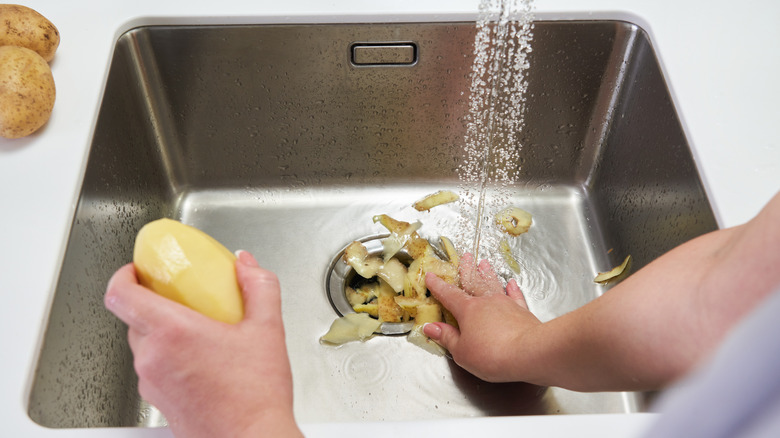
Potatoes are delicious, versatile, and work with almost any recipe or cooking method ... but then comes the peeling part. Of course, there are some peeling hacks to cut down on food prep time, but they don't change the fact you still have to deal with the peels afterward. And while there are many tasty ways to repurpose your potato peels, sometimes you just want them gone from your kitchen as quickly as possible. And the easiest way to do that? If you think it's tossing them down the drain, don't be surprised by the consequences.
Even though it may seem like an easy fix, this practice creates a much bigger problem. Potato peels should never go in your garbage disposal. Travis Hargrave, CEO of Hargrave's Plumbing, a family-owned plumbing business located in Louisiana's Lafayette, shared in an exclusive talk that the peels impact your garbage disposal in two different ways. "They are high in starch and effectively create a buildup that acts like glue around your blades," Hargrave explained.
In fact, a little over two pounds of potato peels can produce around 1.4 ounces of starch, and when mixed with water turns into a sticky paste, commonly referred to as "potato glue," according to Hargrave. This glue, however, slows the blades and sticks to drainpipes. It can ultimately clog the entire system. Additionally, Hargrave said potato peels become very slippery when damp. "Your disposal has a hard time cutting these up, as the blades dull over time," he said.
Potato peel buildup can shorten the lifespan of your garbage disposal
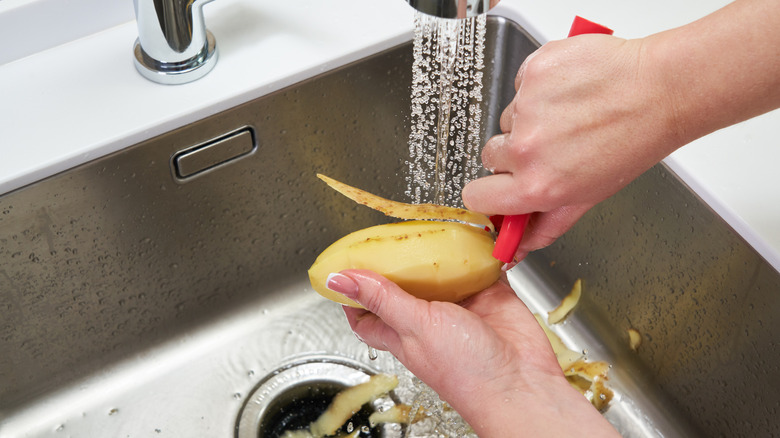
A garbage disposal typically is made up of sharp blades that ground scraps into mush. The waste is later flushed down the drain and ends up in the sewer via the plumbing system. However, as per Travis Hargrave, potato residue is particularly hazardous, as it can affect the system's efficiency and performance. "This substance begins stressing the motor of the unit," Hargrave explained. "If not flushed regularly, the lifespan of the disposal will shorten." Even premium units like the InSinkErator Evolution 1.0HP Advanced Series Garbage Disposal aren't exempt.
When asked what to do after tossing potato peels down the drain, Hargrave recommended turning to a professional to have the unit serviced and sewer lines inspected using hydro (or water) jetting and a camera. "This is the only true way to guarantee a fresh start," he claimed. "Your drains will thank you."
That said, since professionals can charge up to $500 to unclog a sink, you might want to try one of these hacks for clearing a clogged kitchen sink drain first. One particularly efficient DIY solution involves mixing some soap, baking soda, and ice in your disposal to loosen the blockage. "This mix breaks things chemically and with safe friction from the ice," Hargrave explained. Additionally, you could try combining baking soda and vinegar or baking soda and salt for equally effective results. And if that doesn't work, a chemical drain cleaner can be a practical last resort for unclogging the drain, though it comes with risks.