

This Nostalgic American Cereal Needed A Recipe Makeover Before It Could Make Its European Debut
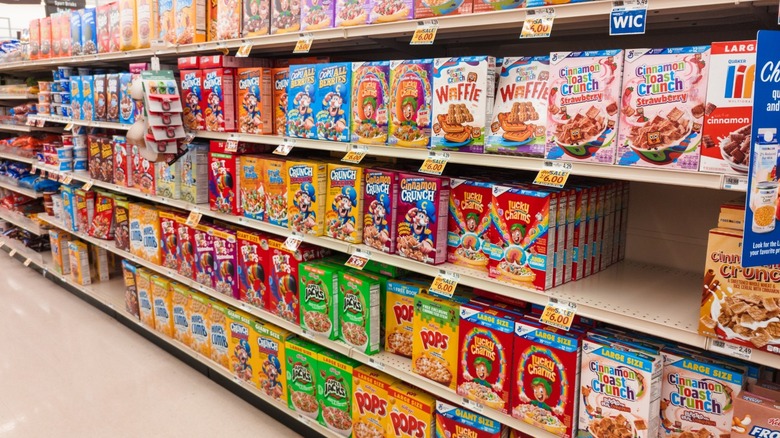
When it comes to food, the United States has a long history of doing things, well, a little differently than other nations, and not always necessarily for the well-being of the general public. Although you can find popular American cereals like Special K, Raisin Bran, and Corn Flakes across Europe and other parts of the world, there's one cereal that had to be reformulated before it could be sold in multiple countries — including much of Europe. The cereal in question is none other than a favorite of many Americans, especially children: Froot Loops.
Just look at those colorful rings and their fun, vivid hues (even if individual Froot Loops do all taste the same). The bright tints aren't ones found in nature; they're kudos to certain artificial dyes restricted for food use in a growing number of places. While Froot Loops are technically not "banned" as a whole product, you won't find the brightly colored American version in countries across Europe, including Norway, France, Denmark, Germany, Spain, Sweden, and the United Kingdom. These countries sell a reformulated version of Froot Loops made with natural fruit extracts instead of artificial synthetic dyes. Some, like Italy, Ireland, Greece, the Netherlands, and Portugal, don't officially sell any version of Froot Loops.
As for America's neighboring countries, restriction on the amount and combination of synthetic dyes that can be used in the same food has resulted in the American version of Froot Loops being reformulated in Canada as well. The same goes for Froot Loops in Mexico, which also come with label warnings about excess calories and sugar.
Artificial dyes have triggered health concerns and different-looking cereal
A main offender in American Froot Loops is blue no. 1, also known as Brilliant blue FCF in Canada and E 133 in Europe, which has been scrutinized for decades for potential toxic effects from its petroleum base. American Froot Loops also contain red 40, yellow 5, and yellow 6, which also come with some global restrictions. Travelers who have found Froot Loops in other countries have made side-by-side comparisons showing a lack of synthetic dyes on the foreign ingredient lists, resulting in duller-colored rings with less color variation. These dyes are also why a variety of popular American snacks are banned in Europe, including Jolly Ranchers and Mountain Dew.
Even without the dyes, the high amount of sugar puts Froot Loops among the worst cereals on American store shelves. Still, there is some argument over how dangerous synthetic dyes may be. Some countries, like Germany, banned blue no. 1 for decades only to permit it in 1998 (though some say this was due to political reasons rather than health perspectives). Even so, greater restrictions on its use remain. In the U.S., the FDA banned red no. 3 in January 2025, and some states, like California, have begun dye restrictions as well.
To its credit, Kellogg (the maker of Froot Loops) announced in 2025 that it would cease using all artificial dyes by 2027. Nevertheless, Kellogg already pledged previously to remove artificial dyes by the end of 2018, as reported in the Associated Press.