

Is Dry-Aging Steak At Home Safe? An Expert Weighs In
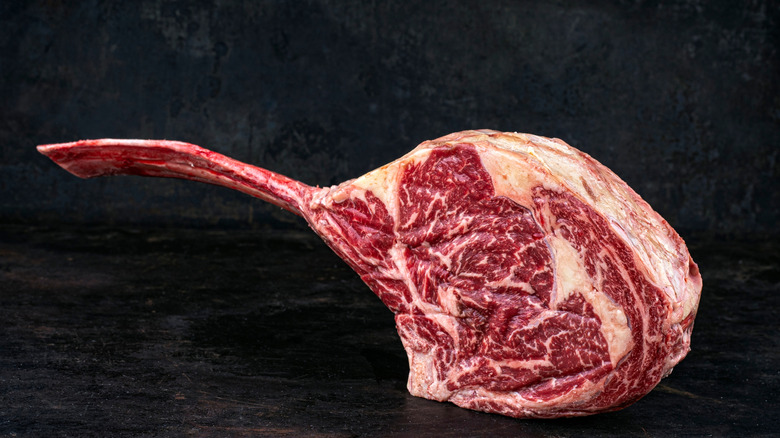
To call dry-aged steak a royal piece of meat would be an understatement. Its flavor intensity, depth of aroma, and that rich, melt-in-your-mouth texture make it truly unique. No wonder it's often considered the gold standard of steak. But that quality comes at a price and can easily cost about $50 per pound. That's why people turn to DIY methods to recreate its complex flavor profile. Still, if you're tired of trying to mimic the flavor of dry-aged beef and you'd like to give the traditional method a go, you should at least know whether it's something you can pull off in your kitchen.
Katie Flannery, COO of Flannery Beef, a California-based butcher shop specializing in dry-aging Holstein beef, revealed in an exclusive talk that while dry-aging steak at home is technically possible, it isn't advised without prior experience. "The biggest issue is temperature control," Flannery told Chowhound, defining this step as the single most important one in the whole process.
Dry aging involves storing meat cuts in a controlled refrigerated environment for weeks or months. Meat is kept at a temperature between 32 and 39 degrees Fahrenheit. Humidity is maintained at an average of 75% to preserve moisture. But in a home setting, recreating these conditions means using the fridge, an appliance that wasn't made for the purpose of dry aging. "Every time you open that door, you're introducing temperature fluctuations," Flannery explained. This can create ideal conditions for bacterial growth. Meanwhile, leftovers and other foods in the fridge can lead to cross contamination.
Safety steps for dry-aging steak at home
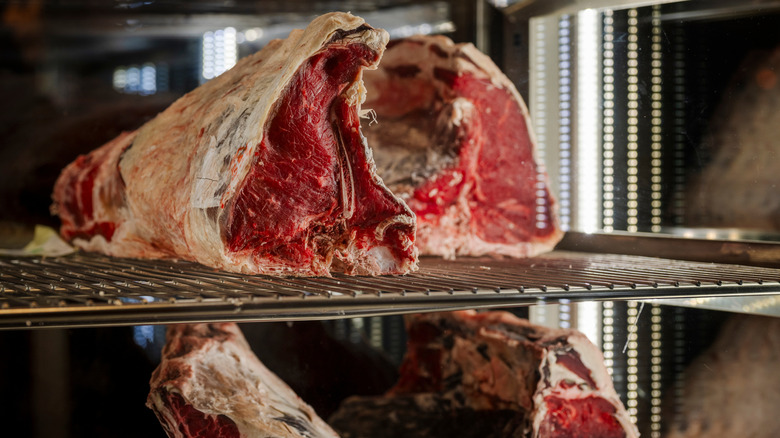
In commercial setups each step of the dry-aging process is closely monitored to ensure best quality. That's how steakhouses transform standard beef into something truly remarkable. But while those conditions are difficult to replicate at home and despite lacking proper equipment or settings, Katie Flannery suggested taking some safety measures if you try this at home.
Buying premium beef is a good place to start. "Start with higher grade beef that has good marbling, because the fat content gives you a little more margin for error," she pointed out. At the same time, get a mini fridge that continuously logs temperature, as well as a small fan for airflow. This small, yet significant, investment limits any potential spoilage and supports the enzymatic processes. It will also maintain consistent conditions to prevent mold and bacterial growth.
That said, if mold does appear, it can leave you wondering if your dry-aged steak is actually safe to eat. If this happens, Flannery stressed not to rely on online sources — specifically about visual cues — to determine whether the mold is harmful. Color alone isn't a reliable indicator. In fact, more than 250 varieties of fungi, including mold, are capable of growing on meat. "[It] is a very persistent myth," Flannery explained. "The only way to know with certainty what you're dealing with is to actually identify the species, which requires testing. Without that, you're guessing." More importantly, temperature is the most crucial variable in dry aging safety. "Control the temperature, control the risks," she concluded.