

Before You Buy A Baker's Rack For Extra Appliance Storage, Make Sure It Has This One Thing
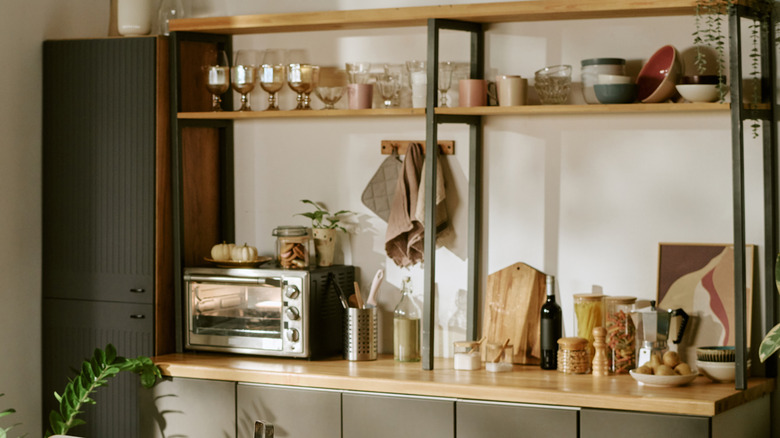
While the name implies they're the perfect storage unit for all of your baking tools and supplies, baker's racks are much more versatile than that. While these open shelving units are great for corralling baking sheets and canisters of flour, in modern homes, the baker's rack is usually used to help intuitively organize your kitchen and improve its flow by offering a sturdy, practical place to store small appliances. Often, this includes items you use daily, such as a microwave, toaster, electric kettle, or coffee maker. If you organize your baker's rack properly, you can easily and safely store and use all of these items together, keeping them within easy reach while freeing up your countertops to prepare classic carrot cake cupcakes with caramelized walnuts, or your grandma's lasagna recipe. This works best if your baker's rack has one essential feature: built-in outlets.
Having the outlets on the rack itself makes it easier to keep all your appliances plugged in safely, eliminating the need for risky setups involving extension cords and surge protectors. The way this works is that the baker's rack contains electrical wiring within its structure, with a dedicated power cord coming out the back. Once plugged in, this power cord activates outlets on the rack, usually located along the side, or along the back of the shelves. Some also feature lighting to help illuminate shadowy shelves, which would be perfect for setting up a DIY coffee bar in your kitchen.
Making the most of the outlets on your baker's rack
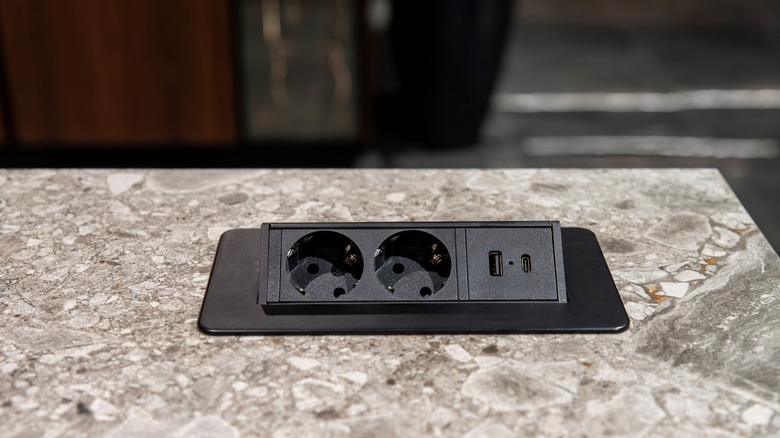
Since the outlets on baker's racks can be located in different places, it's important to assess the placement of the outlets based on the appliances you plan to store on your rack. For instance, if the outlets are clustered along the side of the rack, and your microwave and coffee maker have longer cords, that rack may be a good option for you. However, if you have several appliances with short cords, look for a model with outlets along the back of each shelf instead.
Some people also prefer shelf-based outlets because they make it easier to roll up cords and stash them behind each appliance, whereas the cords plugged into the side of the rack will always be visible. Of course, it's also easier to keep outlets on the side of a baker's rack clean, while those at the back of the shelves are more susceptible to toast crumbs and coffee spills.
Regardless of where the outlets are, these racks are also excellent for easily protecting your appliances from storm-related power surges. Rather than unplugging every appliance, you can simply unplug the baker's rack itself, and plug it in once the danger has passed. Some also have power switches next to each outlet bank, allowing you to keep the rack plugged in but turn the outlets off — a useful feature if you're going to be away from home for a while.