

Easily Fill Cracks In Stone Kitchen Countertops With One Quick Solution
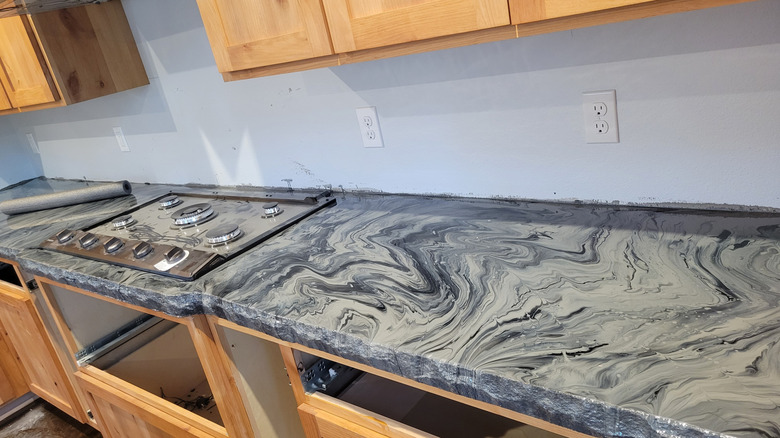
Countertops are one of the most important features in any kitchen. They aren't just a functional workspace — they shape the room's entire character, which is why many people spend a great deal of time exploring their options before choosing a kitchen countertop color, style, and material. However, even if you have an ultra-durable countertop, no material is fully immune from cracks, scratches, or chips.
If your countertop has seen better days and you're thinking about replacing it, you may want to pause for a moment. There's actually an effective solution that can restore its original shine and save you hundreds of bucks instead: two-part epoxy. It's an adhesive polymer coating system consisting of resin and hardener. When mixed, the components trigger a chemical reaction that results in a durable, thermoset bond.
Once applied to a countertop, the epoxy will spread evenly across the material and fill in the cracks and chips, while forming a new protective layer. After it fully cures, the two-part epoxy forms a waterproof, non-porous surface that prevents staining and moisture damage. Most epoxies can handle temperatures as high as 150 degrees Fahrenheit, though some high-heat formulations can withstand up to 350 degrees Fahrenheit. But how exactly do you apply it to fix your damaged countertops?
Bring your damaged countertops back to life with two-part epoxy
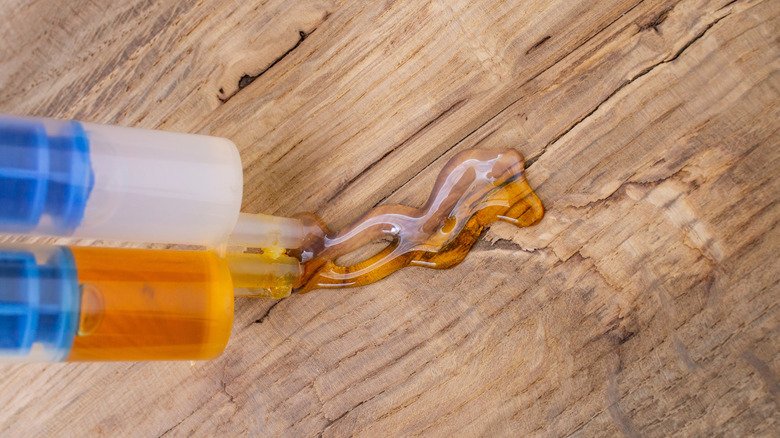
The cost of renovating a kitchen can be astronomical, but this countertop repair method is cost-effective and DIY-friendly. You can find epoxy online and at most hardware stores like Home Depot or Lowe's. To get started, you'll need a few basic supplies: a two-part epoxy kit (resin and hardener), safety equipment, masking tape, a small mixing tool, sandpaper, and a flat scraper or putty knife.
Before you begin the process, wash the chipped part of the countertop with warm water and dish soap. Epoxy won't adhere properly to grease, dust, or grime, and a clean base will ensure a stronger bond. Then stick masking tape around the damaged area to prevent it from leaking onto other parts of the counter. Mix the epoxy by combining equal parts resin and hardener, as an imbalanced ratio can prevent the mixture from curing properly.
Finally, push the epoxy into the countertop's cracks or chips. Begin at the edges and move inward before using a flat tool to level the surface. Let it cure for at least three days, and when the epoxy is fully dry, sand off the excess residue and polish the surface for a refreshed look.