

Don't Store Raw Meat In Plastic Containers Until Taking This One Extra Step
We may receive a commission on purchases made from links.
The kitchen is a paradoxical space, at once both the comforting, warm heart of the home, and a room filled with safety hazards in the form of sharp knives, hot surfaces, and the potential for foodborne illness. That's why it's not only a good idea to follow Martha Stewart's advice in making a kitchen-specific first aid kit, it's also crucial to understand how to store food safely, especially when it comes to raw meat — and no, relying on the smell test alone isn't enough to prevent food poisoning.
Instead, the best way to avoid getting sick involves properly storing your proteins to ensure lasting freshness (about two days for poultry and fish, and up to five days for pork, beef, and other red meats). When stored in plastic containers, this safety window shrinks to just a few hours because plastic containers foster bacteria growth and spoilage, even if stored properly in the refrigerator. The first reason for this is that plastic containers aren't always airtight, so they're notorious for leaking odors and fluids. Plastic containers are also porous and easily scratched or damaged, letting germs accumulate and replicate very rapidly. Combine this with plastic containers' propensity for trapping moisture, and you've basically created a petri dish in your fridge.
However, you can create your own airtight seal by tightly wrapping it in food-safe cling wrap to reduce the potential for accelerated spoilage. Once tightly encased in several continuous layers of cling wrap, you can place the raw meat in a plastic container to protect it from getting crushed, and to help keep the cling wrap from getting torn.
Safely storing raw meat for maximum freshness
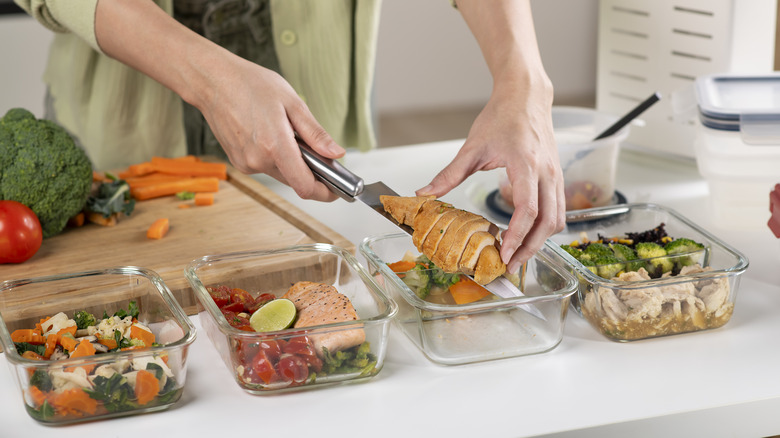
Since an airtight seal and nonporous surfaces are the key to ensuring your chicken stays fresh for your favorite chicken gnocchi soup recipe, it's best to choose a different storage material rather than shoving raw cuts of meat into a plastic container. Glass containers are nonporous, so there's less chance bacteria can thrive, and the lids on glass food containers are often more airtight than those on plastic ones. This makes glass the gold standard for storing food safely in the refrigerator. It's also easier to disinfect these containers, and the more reliable seal shields the meat from oxygen exposure.
Look specifically for containers with matching lids made of hard, clear plastic with a silicone seal around the edge. Some of them even snap into place for extra protection. These kinds of lids are less likely to warp or loosen as you use them. It's okay for the lids to be plastic since they're unlikely to actually touch the meat. Glass containers are also more effective at containing juices that may otherwise leak into your fridge or onto other foods, which would make them unsafe for you to eat.
Though these containers are usually more expensive than plastic ones, they're also more durable, in addition to being safer. That means spending around $30 for a 10-piece set of MCIRCO Glass Food Storage Containers with Snap Locking Lids may be worth the investment, especially since they're also oven, freezer, and dishwasher safe.