

How To Use A Flashlight To Check An Egg's Freshness (Yes, Really)
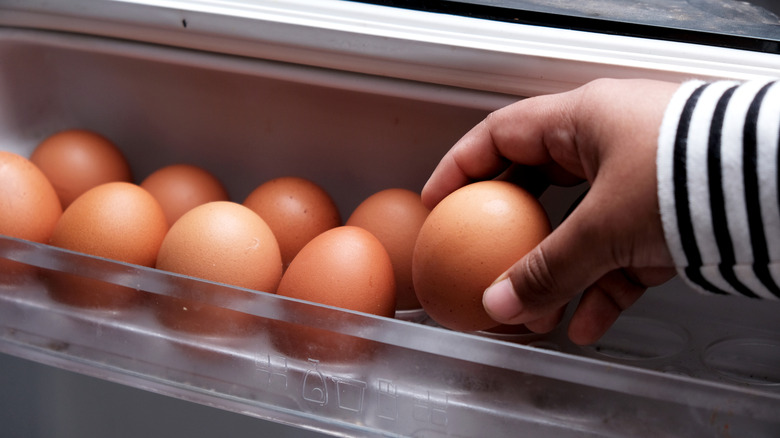
No one wants to eat an egg that has gone bad — and thanks to its protective shell, you can't exactly rely on sight or smell to determine an egg's freshness. You can keep eggs fresh in the fridge for three to five weeks, but since that doesn't give you a specific date to rely on, you might understandably be a bit leery if they've been sitting for a while. Luckily, a handy household item can come to the rescue with a very easy-to-use trick that can tell you if an egg has passed its prime. The next time you have some eggs sitting in your fridge that have been there long enough to fall into the category of "questionable," just grab your flashlight and turn it on.
By shining a light at the large end of the egg, you can illuminate the insides through the shell. The process is called "candling," and it's used by egg packers to check the quality of an egg before it gets shipped out. During this process, eggs are passed in front of a light to check for cracks and other imperfections that can affect the grading. At home, you can use this technique to examine the egg's air pocket, which is the space where air is trapped between the egg white and the top of the shell. As the egg ages, moisture slowly escapes through the shell and is replaced with air, expanding that air pocket. In other words, the larger the air pocket, the older the egg. While this doesn't mean the egg has gone bad, it does mean that it may be reaching its prime and you should use your best judgement about how you use it.
Why checking the freshness of your eggs matters
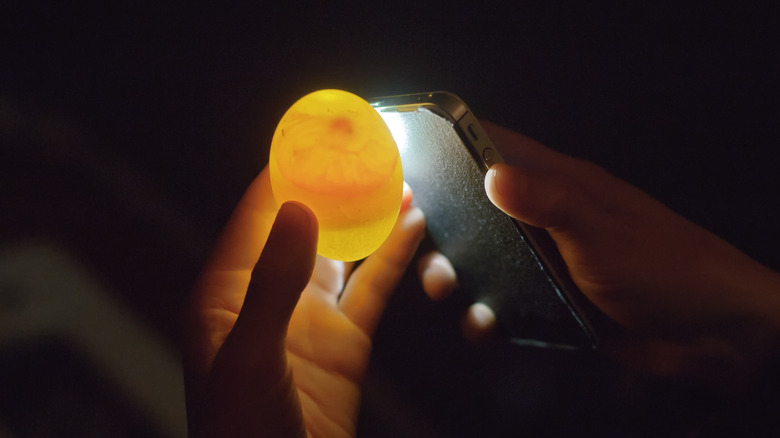
The flashlight test may not tell you if the egg contains dangerous bacteria like salmonella, but it can help you decide how to best use the egg. Oddly enough, older eggs are easier to peel than their fresh counterparts, but that doesn't mean they're best for a plate of sunny side-up eggs. As eggs age, their quality decreases. As long as they aren't past their expiration date, there aren't any cracks in the shell that can let bacteria in, and the color and odor are normal (a foul smell is a sure-fire sign the egg has gone bad), older eggs can still be used for baking.
If you don't have a flashlight handy, you can also use the float test, which requires dropping an egg gently in a glass of water — it floats, it's old. If it sinks and lays flat, it's fresher, and if it sinks but stands upright, it's getting closer to the old side. While these methods can tell you a lot about the egg's freshness, you'll want to look for more obvious signs for contamination issues, like a foul odor or unusual coloring in the egg white (green or pink coloring is definitely a bad sign). In order to see these signs, you'll have to crack the egg first; but if you want to save yourself the trouble of unpleasant sights and smells, you can look for a few telltale signs that don't require cracking the egg open, such as cracks or hairline fractures in the shell or even a foul odor coming through the shell. If you notice any of these red flags, don't eat it.