

Why You Shouldn't Reheat Leftover Food In A Slow Cooker
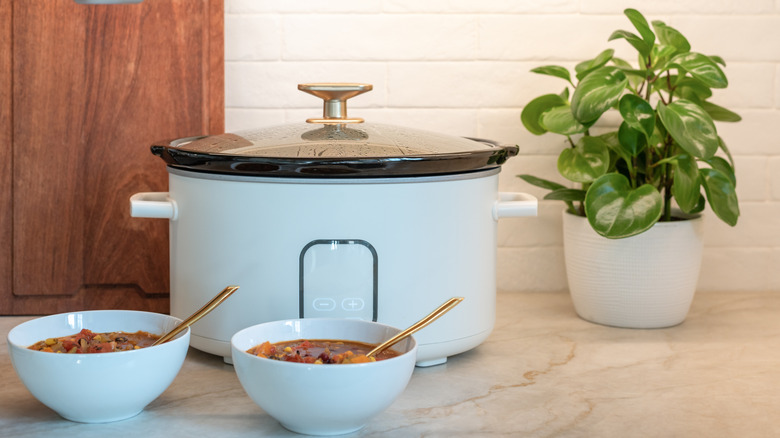
A slow cooker is practically a must-have tool for a cook. You can use slow cookers to make everything from a spicy beef chili for dinner to a delicious breakfast like steel-cut oatmeal. You can even use one to caramelize onions without using the stovetop. But with that much power to cook just about anything, can you use your slow cooker to reheat food and give the rest of your kitchen appliances a break? The truth is, you shouldn't. It will reheat your food for you, but whether it's a good idea or not is a whole different issue. Save your slow cooker for cooking delicious meals and leave reheating to the microwave or other quick methods to warm up your leftovers.
The USDA is pretty clear about how you should be reheating your food, recommending you use the stovetop, oven, or a microwave to reheat food until it reaches 165 degrees Fahrenheit. This helps to prevent foodborne illnesses. Once the food is heated to a safe temperature, however, it can be placed in a pre-heated slow cooker to keep it warm, as long as it consistently stays at 140 degrees Fahrenheit or higher. The slow cooker is designed to cook food slowly over a long period of time, which also means that it heats up slowly. Giving leftovers that much time to heat up from a cold state — possibly several hours — creates the perfect environment for bacteria to move in and take hold, thus making your next meal a potentially dangerous one.
Avoid the danger zone by taking proper care with your leftovers
Slow cooker meals are convenient on so many levels. You can dump some ingredients, turn it on, and go about your day while your dinner cooks. And there are usually leftovers at the end of a slow cooker meal, so you've got lunch for the next day covered. Literally, since you can just put the lid on the cooking insert and stick it in the fridge. But you have to be careful with storing those slow cooker leftovers and reheating them.
Whether the cooking insert for your slow cooker is ceramic or metal, putting it into the fridge while it's still hot can cause thermal shock, a condition that causes the insert to crack or warp from the abrupt temperature change. To make matters worse, the insert will also hold heat for too long, allowing the food to stay in a temperature range that the USDA refers to as the "Danger Zone," (between 40 and 140 degrees Fahrenheit), where bacteria can not only grow, but grow rapidly, raising the risk for food-borne illnesses.
But once you take that insert out of the fridge and stick it back in the slow cooker to reheat, you're starting with an even colder temperature, which will take even longer to heat — once again putting your food in the "Danger Zone." Pre-heating the slow cooker won't help solve the problem, since that will only cause the insert to crack, shatter, or warp, similar to the thermal shock of putting a hot insert into the fridge. It's better to be safe than sorry and follow best practices for reheating your leftovers, meaning the stove top, microwave, or oven.