

Overcooked Salmon Again? Here's How Restaurants Avoid That Problem
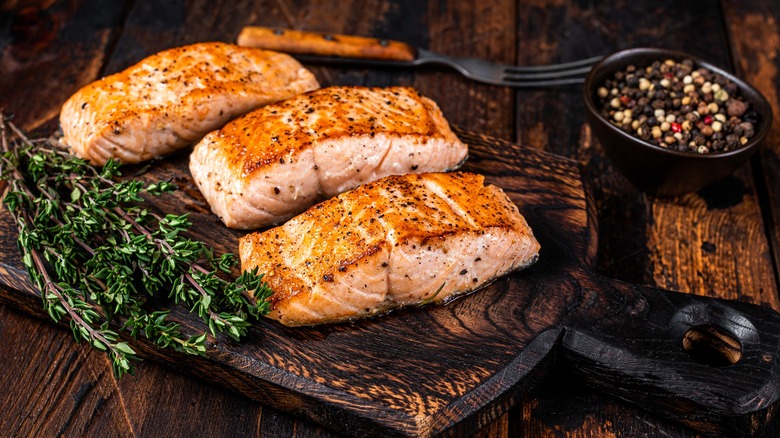
Few seafood dishes hit quite like perfectly cooked salmon. Its soft, buttery flakes melt in your mouth, slowly filling your palate with richness, sweetness, and umami. It's the kind of experience you can only get from delicate fish. It's that same delicateness, however, that makes it hard to avoid one of the biggest mistakes in cooking salmon. It's annoyingly easy to overcook the fish, and if you aren't careful, you're stuck with dry, brittle flakes with a pungent fishiness to them. Restaurants avoid that problem with a solution so simple, it's almost funny: just fold the tail on itself for more uniform thickness.
One of the reasons salmon tends to get overcooked lies in its natural shape. The meat starts out relatively thick towards the head, but then tapers down to less than half its size near the tail. The variance in thickness results in uneven cooking, with the thinner bits usually ending up overdone. By folding the tail end to match the thicker sections of the fish, you're essentially reshaping the salmon into a piece that cooks more evenly. All you need to do is score the tail's thinner end around halfway across its width, then fold the fish along the cut so you end up with a more uniformly shaped block of salmon. It takes a little practice to tell exactly where to slice your fillet, but, once you've mastered this technique, you can cook salmon like a pro. Keep in mind this only works with skinless salmon; the skin traps steam when it's folded in on itself, giving you a less-than-desirable texture in that section.
Other ways to avoid overcooking salmon
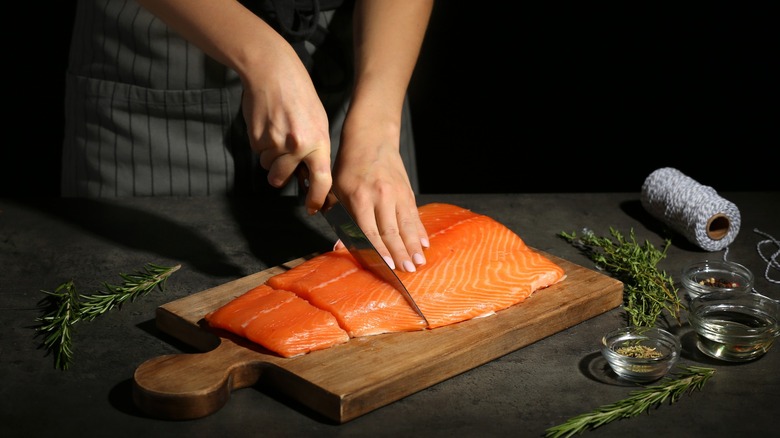
If you're not too confident in your knife skills, there's another way you can shape salmon into a more even cut: turn the fish on its side, then roll it up until you form a thick medallion. Securing the fish with some twine helps the salmon keep its shape while it's cooking, so make sure you have some handy when you're giving this method a go. Check out this video to get a better picture of how it's done:
You can also avoid the problem entirely by slicing your salmon into perfect portions. Rather than folding or rolling everything into shape, just treat differently sized parts as their own cuts. The thinner tail ends can be cut off and sliced into even strips while the thick middle section can be sliced into uniform steaks. While this doesn't give you those drool-worthy, restaurant-style fillets, you at least have the option to use several different recipes for each cut.
Whichever route you go, it's just as important to know the signs of perfectly cooked salmon. The easiest sign to look out for is the texture; if lightly pressing a fork causes it to flake along the white stripes, it's time to take it off the heat. If you smell something fishy, it's gone too far. Don't stress if you can't get it right the first time — there are loads of ways to repurpose overcooked salmon, including turning it into a spread or tossing it into a salad.