

The Secret Seasoning The Best Brazilian Steakhouses Use That Changes Everything
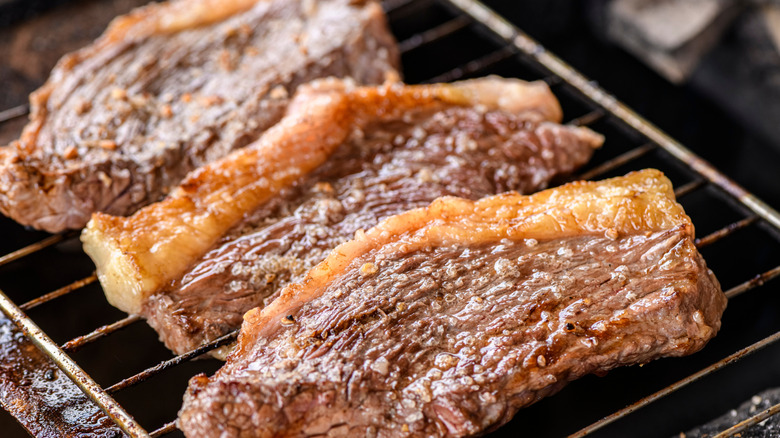
The best Brazilian steakhouses in the U.S. seem to have it down pat. They manage to consistently deliver flavorful bites, so foodies almost never have to worry about dry and bland meat. Evidently, it boils down to seasoning. The surprisingly simple answer is rock salt — or sal grosso, in particular. In a Food Republic exclusive, Brazilian grill master Silvio Correa shared why Brazilian steakhouses swear by this ingredient. "It enhances the natural flavor of the meat without masking it," he said.
In general, as the meat changes color when it's cooked — specifically when it undergoes the Maillard reaction — salt exponentially improves the result, which makes it not only delicious but also quite juicy. But choosing sal grosso — Portuguese for coarse salt – for your meals can make a further difference. It can help the meat's innate taste shine even better, without adding too much sodium to the food, compared to table salt, which is smaller in size. The meat also naturally undergoes a similar process to dry brining, which results in a more flavorful bite throughout the meat. While sal grosso sounds like the king of all salts, it's not exactly the better alternative for all steak cutss — but it is when we're talking about the meat at Brazilian steakhouses.
The sal grosso difference to make your steak more enjoyable
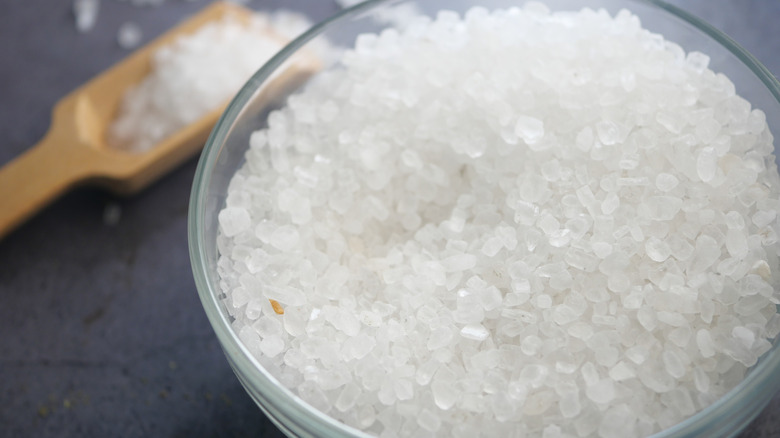
American steakhouses typically rely on rubs and sauces to create a more satisfying plate, whereas in Brazilian steakhouses, it's all about the sal grosso. Even though it's similar to other types of salt, with the only stark difference being its bigger size and coarser texture, it doesn't mean you can easily substitute one for the other; table salt is actually worse for cooking, after all. The subtle nuance between salts — especially in culinary settings — can be quite apparent.
For one, sal grosso clings better to meat — specifically when grilling — which creates a more flavorful piece. Food Republic's expert, Silvio Correa, warned not to salt the meat too early in the cooking process. "If you salt it too early," he said, "it can start pulling out moisture. But when you do it just before grilling, it forms a beautiful crust and keeps the steak juicy inside." You might be surprised by sal grosso's texture at first, which becomes easily detectable when you take a bite. But the delightfully salty crunch can be part of the experience.
To top it off, the specific type that's commonly used in Brazilian steakhouses is a non-iodized variety, which some feel is more flavorful. The quality becomes more obvious if it can't hide behind layers of sauces and seasonings, forcing the salted meat to stand on its own. As such, you could say that by relying on only sal grosso to boost the taste, Brazilian steakhouses must use high-quality meat.
Static Media owns and operates Chowhound and Food Republic.