

The Reason You Never See Aldi In The Pacific Northwestern US
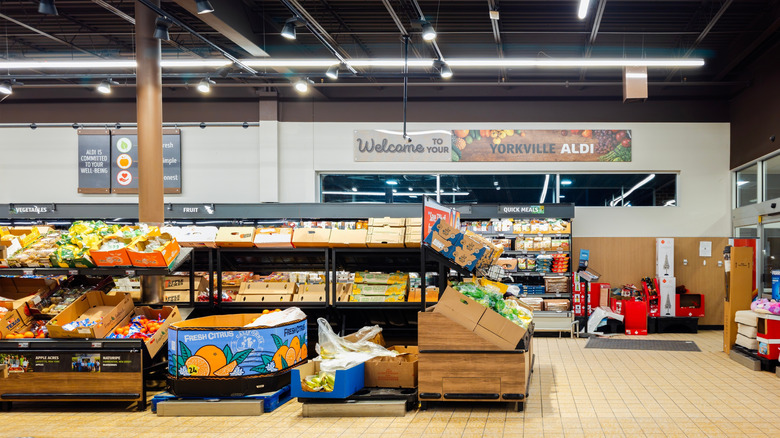
Aldi is the fastest-growing grocery store in the United States, with an aggressive expansion agenda and numerous store openings across the country. Because of Aldi's low prices and famous dupes that taste like the real thing, Aldi has developed a huge following. However, you won't see an Aldi location in the Pacific Northwest. There are a few reasons for this, including the most basic factor for predicting a store's success within a particular market.
Aldi is considered on average to be the cheapest grocery store in America, though other factors that make an Aldi location successful are just as powerful as its reputation. Aldi runs more than 2,500 U.S. stores, but as of yet, there hasn't been an announcement for adding locations in the Pacific Northwest. One reason may be due to Aldi's criteria for opening new stores, and what's needed for a store to become successful. To open an Aldi location, there are property requirements that need to be taken into account. Among other requirements, a new store must be located within 3 miles of a dense population area, be situated in a shopping district that's zoned for grocery stores, and have a minimum daily traffic count of at least 20,000 vehicles. All of these factors have an effect on the number of people shopping at Aldi, determining if a new location is able to grow. The Pacific Northwest may not provide an adequate foundation for opening new stores based on these restrictions.
How the Pacific Northwest compares to locations throughout the country
Encompassing Oregon, Washington state, and Idaho, the Pacific Northwest region of the United States is geographically isolated, as it is surrounded by dense forests, ocean, and the Cascade mountains. Even with dense populations in Seattle, Tacoma, and Portland, it doesn't have major urban hubs on a level that might be expected for a such a large, scenic area with coastal access. Some Reddit users on the subreddit r/Aldi speculate that because of the isolated environment, Aldi needs to consider growth rate and supply issues before it opens new stores.
Though Aldi is regularly recognized as one of the country's favorite grocery stores in surveys and is among the three largest U.S. grocery retailers, its footprint is mostly found in the Northeast and Midwest, along with a large number of stores in Florida. Aldi is currently slated to expand into more Western states, including opening stores in Southern California and Arizona, while currently holding down a western presence with two new stores in Las Vegas. In addition, Aldi purchased Southeastern Grocers, the parent company of Winn-Dixie and Harveys in Supermarket in March of 2024. It will convert select Winn-Dixie and Harveys Supermarket stores to Aldi's format in 220 locations through 2027, cementing Aldi's presence in the southern United States. Although there are some shopping myths about Aldi that shouldn't be believed which might affect the store's overall popularity among some people, having already-built grocery retail outlets and shoppers familiar with the locations makes opening store in the southern United States much more feasible.