

Here's How Long You Can Soak Your Dirty Dishes Without Them Becoming Germ-Ridden
We've all done it: left dishes in the sink to soak because we didn't feel like washing up immediately after cooking. But while there are genuine reasons to soak your dishes — it can make them easier to clean later, for one — there's a limit to how long you can safely leave them sitting in water. Chowhound asked Edmund "Ed" McCormick, food science and formulation consultant, author of The Food Questions America Is Asking blog, and CEO of Cape Crystal Brands, to outline some food safety mistakes to avoid when it comes to soaking dishes.
The main issue is that food left on dirty dishes can encourage bacteria growth when they're submerged in water. "It only takes minutes for the dissolved nutrients of the submerged food to break down, releasing carbs, proteins, and lipids, which comprise a bacteria diet," McCormick explains. As a general rule of thumb, he says, don't leave dishes soaking for more than one to two hours. However, certain factors — temperature and the types of food left on your dishes (meat, dairy, and eggs in particular) — cut that window down to about 30 to 60 minutes.
McCormick says you'll be able to recognize that your dishwater is unsafe by visual, olfactory, and tactile cues, including cloudy water, visible food debris, and a greasy film on the surface of the water; a sour smell; and affected surfaces feeling slimy. If you notice these signs, instead of washing your dishes as you would normally, he says, "empty your sink completely, then rinse your dishes under hot running water, and finally, refill your sink with clean and hot water." Of course, if you still aren't ready to deal with your dishes, McCormick explained the factors that speed up and slow down bacteria growth, and how to navigate them.
What speeds up or slows down bacteria growth when soaking dishes
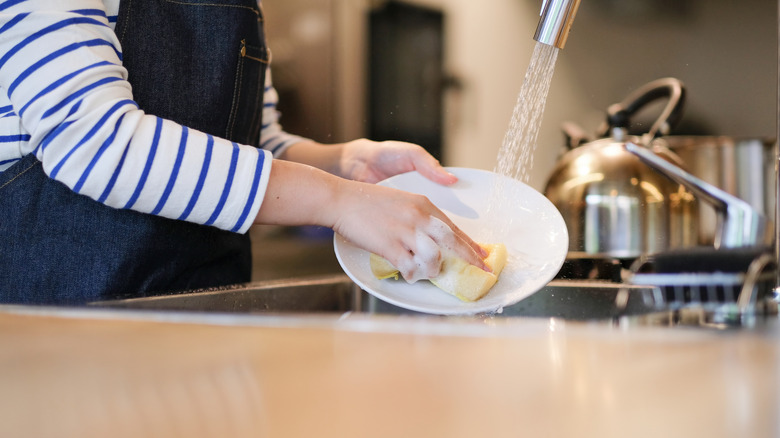
There are several factors that can facilitate the growth of bacteria when soaking dishes. First, water temperature. Ed McCormick explains, "Water that is between 40 degrees Fahrenheit and 140 degrees Fahrenheit is considered within the 'danger zone' by the USDA, where bacteria will double every 20 to 30 minutes." The type of food residues can also become cause for concern. "Foods rich in protein and starch (like dairy products, sauces, meat, eggs, pasta), when left in water, will decompose and provide ideal breeding sites for Staphylococcus, E. coli, Bacillus, and Clostridium," McCormick says. Warm kitchens play a role, too. "Even a mild room temperature promotes microbial growth," he says. And finally, the availability of oxygen in the dishwater that can help certain bacteria thrive. "Once the bacteria reach a critical level, they form biofilms on the dishes, which are layers that make the dishes difficult to clean," McCormick continues.
If you can't clean your dishes right away, you can at least slow bacteria growth. McCormick recommends starting by getting as much food off the dishes as you can by scraping and rinsing them. Use a pre-soaking spray with enzymes to help break down the food faster. He also recommends stacking your dishes in the sink. "Drying the dishes by stacking them is better than leaving them immersed in warm water," McCormick says.
And if you do want to soak them, always use cold water — and add a drop of dish soap. The soap helps "break the membranes of the bacteria," he explains, which doesn't significantly increase the amount of time you can soak the dishes. "Nonetheless, it plays an advantageous role in emulsifying grease and suspending soil," McCormick says. Combined, these factors can help make washing your dishes easier without soaking them for longer than is safe.