

How One 1930s General Store Grew Into A Giant Grocery Chain
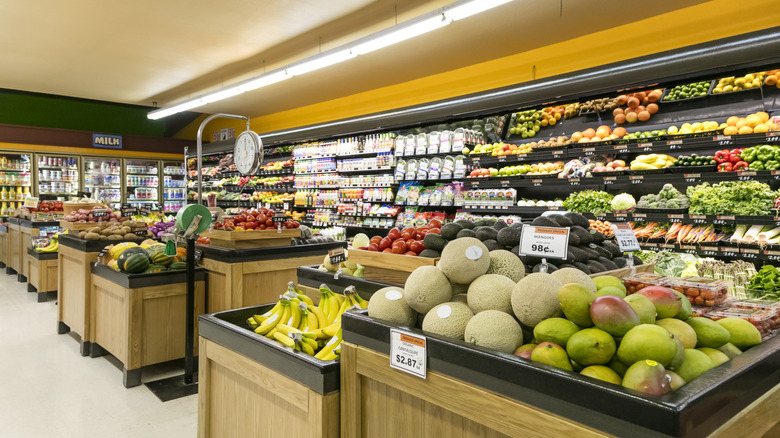
A handful of coal and a diamond: What's the difference between the two? Time and pressure. Maybe that sounds a bit cheesy, but it also has a good bit of truth to it. Some of the best things in life come from periods of difficulty. Take, for example, the humble meatloaf. The American dinner staple became ubiquitous only as the Great Depression caused millions of home cooks to get creative with their cooking. Tasty as it is, meatloaf isn't the only American treasure to have emerged from this dark period in American history. Hy-Vee, one of the most popular Midwestern grocery chains, got its start all the way back in 1930, just after the infamous Black Friday market crash.
Before Hy-Vee was the bustling supermarket chain that it is today, however, it started out as a humble neighborhood general store founded by Charles Hyde and David Vredenburg. The store relied heavily on credit and bartering with customers who were working with few resources in the midst of a decade-long economic crisis. As the business expanded, Hyde and Vredenburg gave store managers and employees the ability to set their own policies and give input into company wide decisions, a policy that still stands to this day. Over the decades, Hy-Vee has morphed from local supply store to multi-state supermarket chain. Along the way, the chain has stuck to its simple, collaborative roots and is an employee-owned endeavor, similar to the quintessentially Southern Publix grocery chain, which is also employee-owned.
More on Hy-Vee's history
In order to fully understand what makes Hy-Vee stand out, we must look into the line between its first location and its current status as a Midwestern staple. After all, Hy-Vee boasts an impressive 240-plus locations across eight states. So, how did we get here? To start, Hy-Vee wasn't originally called Hy-Vee. The original name, Hyde & Vredenburg, came about in 1933, the same year the original location closed. That same year, Hyde and Vredenburg decided to begin a profit sharing strategy for their store managers at their other locations. This policy formed the foundation of the chain's focus on giving individual locations as much independence as possible. The Hyde & Vredenburg partnership briefly came to a close in 1935 due to an Iowa state tax law, but when the law was dissolved, the two rejoined their business partnership.
Employee ownership was established in 1938, when the business was incorporated. It wasn't until the 1940s, however, that Hy-Vee began to modernize into the supermarket that it is today. Features such as shopping carts, in-store music, and a frozen aisle were added at this time, even if customers were wary of some modernizations (the carts in particular were a bit of a hard sell to some). In 1952, the chain was renamed to Hy-Vee, which has stuck around for over 70 years — along with the chain's reputation for location independence and quality goods.
The grocery chain's enduring legacy
Even at nearly a century on since its initial founding, Hy-Vee maintains a reputation as a beloved grocery chain. Midwesterners from Iowa to Minnesota (and even Missouri and Nebraska) sing the supermarket's praises. What makes Hy-Vee so special? For starters, Hy-Vee doesn't just limit its offerings to groceries. Hy-Vee offers an extensive selection of wellness products, supplements, bath and body products, beauty products, and spirits. Like many grocery chains (think Kroger and Giant), Hy-Vee also has coffee available in-house. Unlike Wegman's, which has its own cafe, Hy-Vee locations often have a Starbucks or Caribou Coffee (a Minnesota-based coffee chain) in-house.
Beyond this, each Hy-Vee is deeply rooted in its local community. The grocery chain often goes out of its way to offer relief during, and in the wake of, natural disasters and extreme weather emergencies (and in the Midwest, these aren't exactly rare). Though many things have changed since Hyde and Vredenburg opened their first shop, the company's values of community engagement, employee involvement, and location independence remain intact.