

Should Your Water Be Scorching Hot To Make Good Coffee?
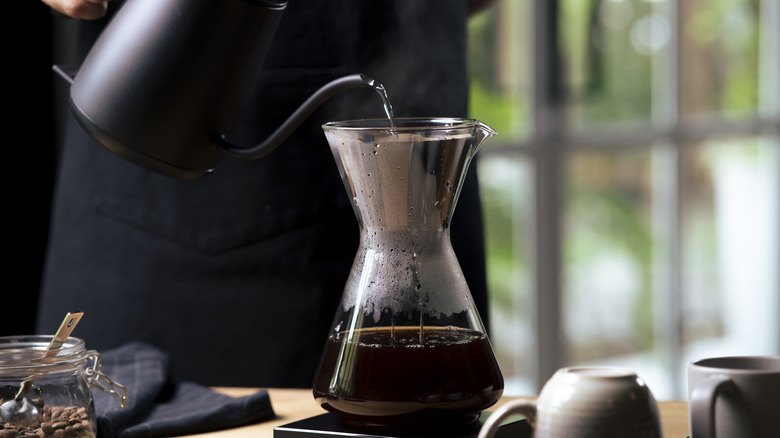
There are a number of factors that influence the quality of brewed coffee, and certain steps are non-negotiable for ensuring an optimal brew. This includes the best type of water to use for your home-brewed coffee, as well as paying close attention to the temperature of the water, which is a key variable when making coffee. Interestingly, the verdict on whether or not you should use boiling water for brewing coffee appears to be a point of unclarity.
Novice baristas are often taught brewing coffee with boiling water is a major no-no in the industry, as it can allegedly scorch the coffee and yield an unpleasant taste. However, a body of coffee professionals — one of which is James Hoffman, a renowned coffee consultant and expert with a dedicated YouTube channel on all things coffee — make the case for using boiling water, especially for filter coffee, arguing boiled water is better suited for consistent results. To this day, there is a growing discourse that challenges the notion boiling water actually scalds the coffee, while some connoisseurs remain advocates for preparing coffee with a water temperature below boiling point.
To boil or not, that's the question
Even though an organization like the Specialty Coffee Association, a global coffee trade non-profit, specifically recommends brewing coffee with water heated to a temperature just below boiling point (212 degrees Fahrenheit), ranging between 195 degrees and 205 degrees Fahrenheit, this may not be feasible if consistent results are of the essence. For home brewers and even some coffee shops, there might not be access to electric kettles with accurate temperature readings or coffee machines where you can pre-program the desired water temperature. In these instances, using boiling water allows both professional and home baristas to keep things consistent.
Further countering the theory that boiling water will burn coffee is the notion the roasted coffee beans have already been subjected to an incredibly high temperature, to the tune of over 400 degrees Fahrenheit. So, subjecting coffee to boiling water is not likely to roast the beans any further. From a scientific standpoint, the jury is still out on whether boiling water actually does scald coffee or if it's merely the effects of the bean's extracted compounds and the resulting taste. To address this, there does appear to be emerging research that explores the effects of water's temperature on the flavor of coffee.
How water temperature affects coffee's taste
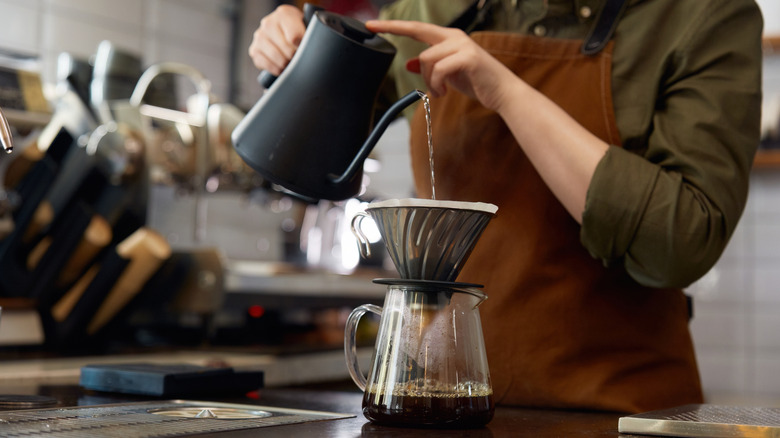
A good-tasting brew boils down to drawing out flavorful compounds that enhance coffee rather than yield a bitter result. The hotter the water, the higher the count of total dissolved solids (TDS), which accounts for organic and inorganic compounds measured in water, and thus, increasing what's extracted from coffee. Since TDS is used as a measure of soluble compounds, its percentage affects the flavor and strength of your final brew. Time is also a key component. Too short of a brewing duration means a higher concentration of organic acids relative to other compounds, resulting in sharper tasting notes. Over-extracting coffee can draw out lingering, unwanted compounds that can also ruin the taste. However, depending on the roast, a higher water temperature may extract more burnt and smoky flavors.
According to Food Research International, a 2009 study of how water temperature affects coffee's chemical-physical and sensorial properties, reported a proportional increase in extracted compounds with the water temperature used for making espresso. Samples brewed at 212 degrees Fahrenheit were ideal while those at 230 degrees Fahrenheit were considered over-extracted. This indicates boiling water might not ruin the taste of your coffee. Conversely, a 2020 study in Scientific Reports found water heated to sub-boiling temperatures (roughly 188 degrees to 199 degrees Fahrenheit) had no notable impact on coffee's taste. The study suggested TDS had more to do with the end result rather than water temperature. So, is there a temperature sweet spot for brewing coffee? The answer remains unclear. Learn to taste your coffee like a real connoisseur and decide for yourself.