

The Types Of Requests That Cause Restaurant Chefs The Biggest Headaches
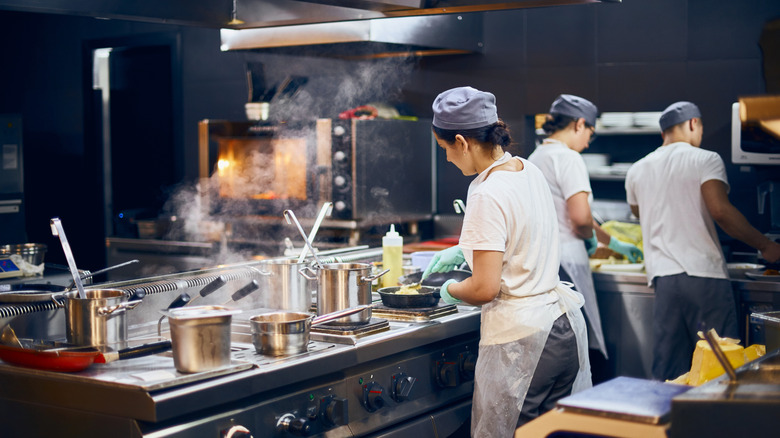
In an age when going out to eat is seen more as an indulgence than an everyday occasion, it's no wonder that when we do dine out, we want everything to be perfect. Achieving that can be as simple as avoiding the overpriced menu items that are rarely worth it, but some diners take their preferences a step further by asking for modifications. Many restaurants are happy to oblige, while others — fine-dining establishments in particular — have strict policies against modifications, even for dietary restrictions.
Chowhound spoke with Brandon Dorsky, co-owner and consultant of Bagel Lords, which operates nine Yeastie Boys Bagels trucks in Los Angeles, and Jerry Micciche, executive chef at Peter & Paul's Hospitality Group, to find out what makes a request particularly burdensome to restaurant kitchens. According to Dorsky, "Customer requests that require additional cooking time or preparation time are the most disruptive during a busy shift."
Micciche concurs. "Some modifications seem simple from a customer's perspective, but are not that simple," he tells us. Asking for no seasoning, for instance, may require chefs to prep a customer's meal separately using different methods, as can asking for sauce on the side. Requesting a different cooking method, like grilled instead of fried, is also a hassle. "This requires another chef to focus on this plate for one particular client and often means we need to use different equipment," Micciche explains.
How to get what you want without burdening the kitchen

It may seem harmless to request a simple modification when dining out. After all, you're only one customer, right? But as chef Jerry Micciche explains, "modifications multiplied in a busy service can overwhelm the line." That doesn't only lead to back-of-house stress — it may also affect the service you receive in the dining room. "Menu hacks often lead to slower service, because chefs are cooking something that is not in the standard workflow, [resulting in] inconsistent results, which customers sometimes blame on the kitchen," Micciche says.
Too many removal requests can also compromise taste. "I often get the request for no seed oils or butter/diary, which makes achieving exceptional flavors difficult," Micciche admits. Still, that doesn't mean that you can never make requests — you just have to take special care when ordering off-menu. One of the best ways to do so is by calling ahead, Micciche advises. "Food and entertaining people is a chef's passion," he says. "If we can assist and make changes to enhance or accommodate the guests, it would be our pleasure!" If you do find yourself making requests on-the-fly, Micciche notes that omissions are easier to accommodate than substitutions.
Finally, don't be shy when it comes to communicating serious restrictions. "A best practice for customers with food sensitivities is to provide information concerning allergies at the start of your order, and repeat [it] at the end of the order," Brandon Dorsky says. "A customer specifically requesting preparation on a clean surface and [with] fresh gloves and utensils helps send a signal that the allergy is severe and not merely a food preference."