

What It Means If A Restaurant Gets A Failing Health Score
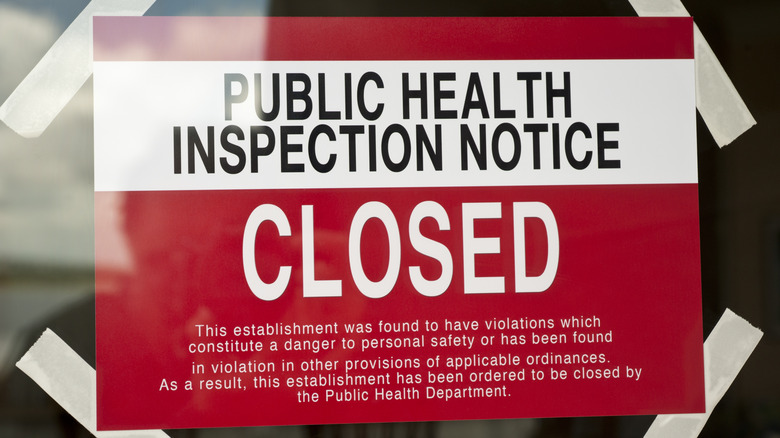
So, your favorite restaurant is in trouble with health inspectors, and you just ate there: Should you be seriously worried for your health? Health inspection rules vary by location, but it's safe to say that it's not ideal.
That's because every U.S. jurisdiction bases its rules on the FDA Food Code, which sets baseline standards for food safety. A failing score generally means inspectors found one or more "priority" or "critical" violations: issues considered likely to cause foodborne illness if not fixed quickly. Big problems include unsafe food temperatures, cross-contamination (especially when it comes to bad practices handling meat), and problems with handwashing or sanitizing food preparation tools and surfaces. Serious problems that can't be fixed quickly, like a vermin infestation, can get a restaurant immediately shut down, but a restaurant can also fail by racking up several smaller violations. These include things like dirty floors (or dirt in a place where food isn't stored or prepared), cracked tiles, bad ventilation, or staff without properly secured hair.
It's important to know that some restaurants can remain open after failing an inspection. Though food inspection authorities don't always spell out every possible issue or consequence on their websites, that's likely in cases that a restaurant has several small problems that don't pose immediate health risks. But they'll probably still be fined, and the restaurant will face reinspection very soon after. That's why it's important to understand what the violations really mean when trying to determine risk.
The problems behind failed health inspections

A critical (aka priority) violation is one on a list of food safety mistakes that can potentially make you sick. For example, if a restaurant is dinged for unsafe food temperatures, it means they're leaving food in the "danger zone" between 41 and 135 degrees Fahrenheit for too long — it's sitting out rather than in the fridge/freezer or on the stove ready to serve. That allows bacteria to multiply rapidly. Soft-serve machines are a food safety nightmare for this reason.
Another frequent issue is the cross-contamination that happens when tools or surfaces used on raw meat are used to prepare other foods without being washed and sanitized. Problems with handwashing are also considered critical, so much so that inspectors look for both employees who skip it and anything that could prevent it, such as empty soap dispensers, a lack of hot water, or blocked sinks.
Finally, there are various issues you can loosely attribute to a restaurant's physical premise, such as a mouse or rat infestation, backed-up sewage, or no water supply (which would prevent washing). In many (if not all) jurisdictions, these types of issues could cause inspectors to immediately shut down a restaurant.
How to know if a restaurant failed an inspection
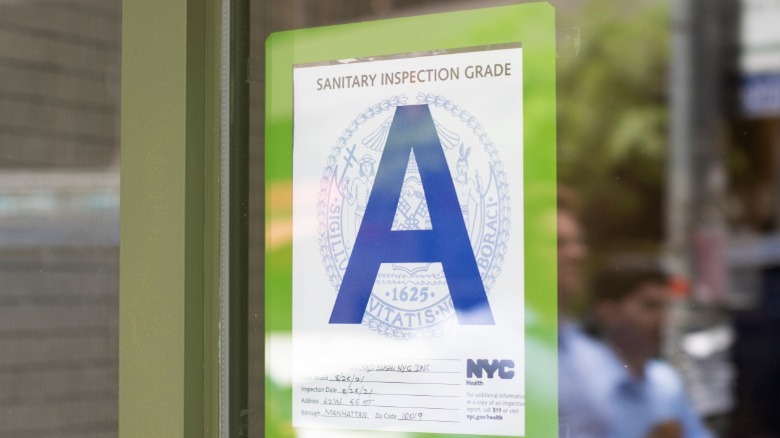
This is the tricky part because there's no uniform U.S. system for restaurants displaying their health inspection results. In New York City, restaurants have to post health inspection scores, although confusingly, the worst grade is a C, not an F. This system is used in many cities: C means the restaurant has serious violations and is at risk of being shut down, B means minor violations, and A means few (if any) violations. If inspectors close down a restaurant, there will likely be a sign from local officials indicating the closure, regardless of the scoring system.
However, some jurisdictions don't use letter grades or a comparable system, instead using less intuitive systems that may not be as obvious, like Seattle's color-coded health inspections. In these cases, you may need to be proactive. For example, in Utah, there's now a QR code that links to a restaurant's report, while in Portland, Oregon, restaurants only display a notice that they passed.
But if you can't find a score or you want more information, many cities keep public databases of health inspection reports online, and they're often easy to search. That's also useful if you want to check a restaurant's inspection history since a score on the window only reflects a restaurant's last inspection.