

Can You Really Add Too Much Seasoning To Brisket?
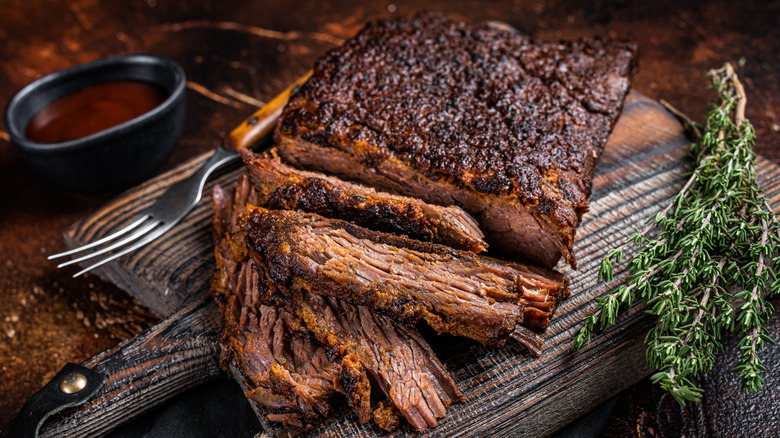
When you're working with a large cut of meat like brisket, is over seasoning really a concern? We sat down with lifestyle and cooking content creator Tyler Speegle (@tylergrowthlife) for an exclusive interview at the New York City Wine and Food Festival. As it turns out, showing restraint while seasoning may actually come back to bite you (and leave you wanting fewer bites of your brisket).
"[You can't] really go wrong with adding too much seasoning," Speegle shares, since such a substantial cut can handle a lot of spices and often requires it. He recommends fully coating your brisket in seasoning until nothing else sticks to it. While such a heavy hand may sound daunting (after all, under seasoning is typically one of the most common seasoning mistakes everyone makes), it's not only essential for flavor but also for the formation of bark — the rich brown crust that forms during cooking.
Since brisket is full of connective tissue, it's cooked low and slow to break it down, resulting in tender, fall-off-the-bone meat. But during a lengthy cooking process, seasoning doesn't just sit on the surface — it completely transforms. As moisture on the meat's surface dries out and fat begins to render, the brisket rub undergoes the Maillard reaction (a chemical reaction between amino acids and sugar that begins at 285 degrees Fahrenheit) and bark forms. But a thin layer of seasoning won't cut it. If there isn't enough rub on your brisket, you can run into bark formation complications. So season confidently — your bark is relying on it.
Mistakes to avoid when seasoning brisket
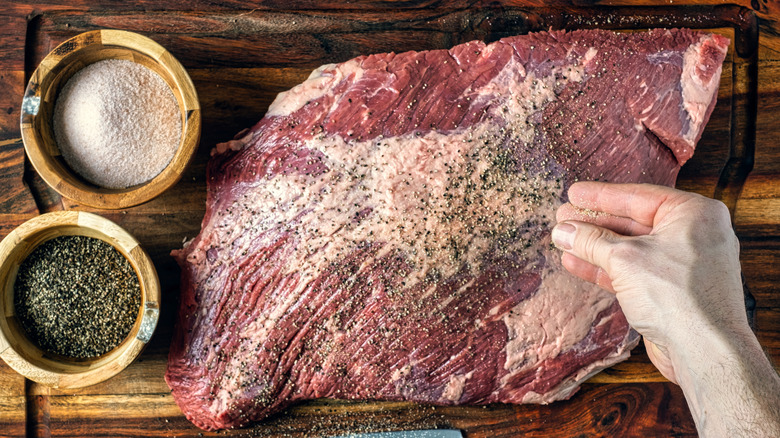
While Tyler Speegle is adamant you can't over season brisket, he also cautions you can't just throw whatever you want into your rub. Even if you select the best brisket at the store, things can go awry if your seasoning is off. So what are some common seasoning mistakes to avoid?
For starters, steer clear of excessive sugar. "I wouldn't use something that's too sweet," Speegle warns. While sugar is a crucial component for the bark-forming Maillard reaction, adding too much could cause caramelization (which is different from the Maillard reaction), resulting in your bark becoming overly thick and cloyingly sweet as a result.
It's also crucial to anchor your rub with salt (though beware of how much you incorporate). Speegle explains salt is less prone to burning, which helps your slab of meat avoid an over caramelized fate. This staple ingredient also helps brisket stay more tender and moister by binding with water that reabsorbs back into the meat, thus helping it retain moisture and break down proteins during the cooking process.
But even a moisture-booster like salt has limits. Using too much of it can lead to the opposite fate and leave your brisket dry and overly salty. Ultimately, Speegle's advice boils down to balance. You can (and should) use a lot of seasoning to get that thick, rich bark, but make sure your ratio of seasonings is correct.