

How To Substitute Honey For Brown Sugar When You're In A Pinch
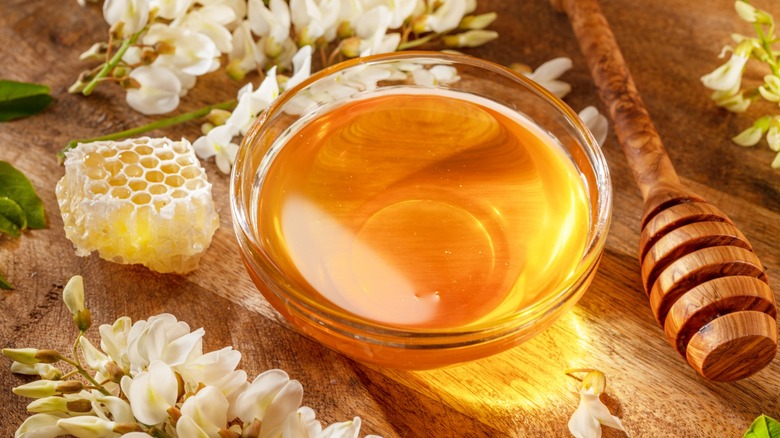
It's a gutting feeling when you're getting a recipe together and you realize you're short one crucial ingredient. But if you're whipping up a sauce or a batch of cookies or anything in between and find yourself with no brown sugar, don't fret — all you've got to do is reach for your bottle of honey. Honey can be used in a variety of ways when cooking and baking, including as a little cheat code for getting satisfying grill marks on your steaks, and it can also be a super-sub if you're lacking brown sugar. However, it requires a bit of know-how to do so.
This is where Kantha Shelke, PhD comes in. Shelke is not only the CFS (Certified Food Scientist) Principal for food science and research firm Corvus Blue LLC, but she is also a Senior Lecturer of Food Safety Regulations at Johns Hopkins University. Although she says that substituting honey for brown sugar is perfectly doable, it'll require some tweaking depending on what you're cooking or baking. On the whole, though, she suggests a few all-but-universal rules: "replace 1 cup brown sugar with ¾ cup honey," "reduce liquid in recipe by ¼ cup per cup of honey used," "lower oven temperature by 25 degrees Fahrenheit," and "add ¼ teaspoon baking soda per cup of honey." Following these guidelines should make your switch (and your cuisine) as seamless as can be when your brown sugar goes astray.
What to consider when swapping sugar and honey
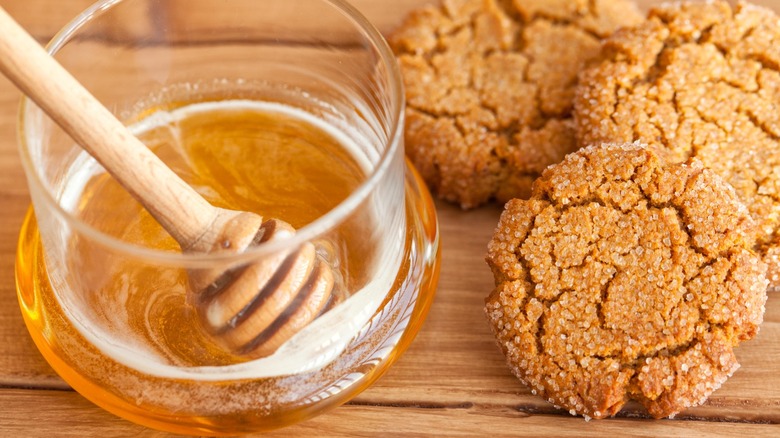
Even though you can use honey as an adequate substitute for brown sugar, that doesn't mean that these two ingredients can be treated as like-for-like equals. For example, brown sugar, unlike white sugar, has a distinct molasses note which most honey simply lacks — so you shouldn't expect your dish to taste exactly the same. Nor should you expect them to give you the same result texturally, since, as Kantha Shelke states, "honey (with 17-20% water) is hygroscopic (i.e., it attracts moisture and retains moistness) and contributes to softer, moist baked goods that stay tender longer."
It's also important to note that, especially when baking, you have to pay attention to how much extra liquid is being brought into the equation on account of the honey. "Precise liquid ratios affect gluten development, leavening, and structure," says Shelke. "Excess moisture can lead to dense, gummy textures or prevent proper rise." This is why you should "reduce other liquids by ¼ cup for every 1 cup of honey substituted. This compensates for the 17-20% water content of honey." Honey is also more acidic than brown sugar, hence Shelke's recommendation to supplement your recipe with a touch of baking soda to mellow out this acrid touch.
Cooking with honey has its limits
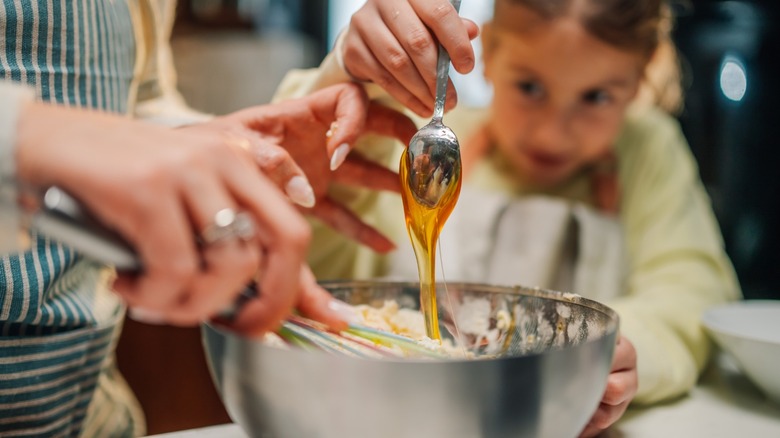
Honey is sweeter than brown sugar on account of its higher fructose content. While this is a net-positive in many aspects, it also means that cooking with honey is a little more volatile than cooking with regular sugars. "Honey caramelizes at [230 degrees Fahrenheit] while brown sugar caramelizes at [320 degrees Fahrenheit]," says Kantha Shelke, advising to "watch for faster burning with honey." She continues, saying to "use medium-low heat with sugary glazes to prevent charring; monitor closely as sugar caramelizes quickly."
With all of this said, though, not every recipe under the sun is going to work well if you sub out your brown sugar in favor of honey. Shelke gives a number of examples, most of which have to do with the structural aspect of brown sugar. "Honey substitution fails in recipes requiring creaming method (e.g., pound cakes, butter cakes, sugar cookies) because brown sugar crystals create air pockets when creamed with butter and this is essential for structure and tender crumb," she says as an example. She also says that toffees, brittles, and similarly crispy goodies won't turn out as crisp with honey. "In baked products like meringues and angel food cakes that depend entirely on the sugar to stabilize the egg white foam, honey fails because it deflates foam immediately," she adds. So while it isn't a be-all-end-all substitution, honey can still get the job done in some cases, as long as you adjust your recipe as needed.