

The Magical Thing That Happens When You Encrust Your Prime Rib With Salt
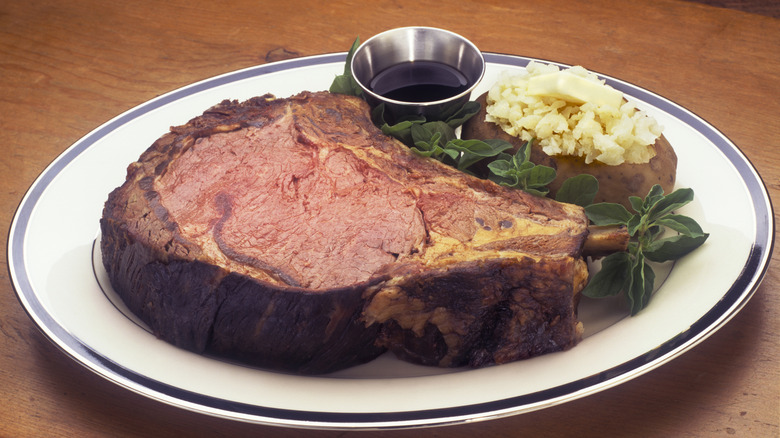
The festive season is just around the corner, and for many chefs, that means roasts are on the brain. While not strictly a wintertime dish, a gorgeously roasted prime rib with all the trimmings is just what we crave when the temperature drops. It's also the kind of cooking that rarely calls for innovation: Big piece of meat, hot pan, hot oven — the way it's been done forever. While methods like slow roasting and the reverse sear work well here, there's one unusual technique that will give you a truly magical, almost unbelievably juicy roast: a salt crust.
Essentially, this method encrusts the entire cut in a thick, almost cement-like layer of salt that seals it up and keeps everything nicely concentrated while your meat cooks. When you eventually break the shell and extract your roast, all those juices that would usually evaporate during cooking remain locked inside, resulting in divinely tender meat. This method is especially effective with prime rib, a cut that demands care and precision. As the name suggests, it's a prime piece of meat, and the goal is even cooking and perfect juiciness from edge to center.
Why the salt crust works
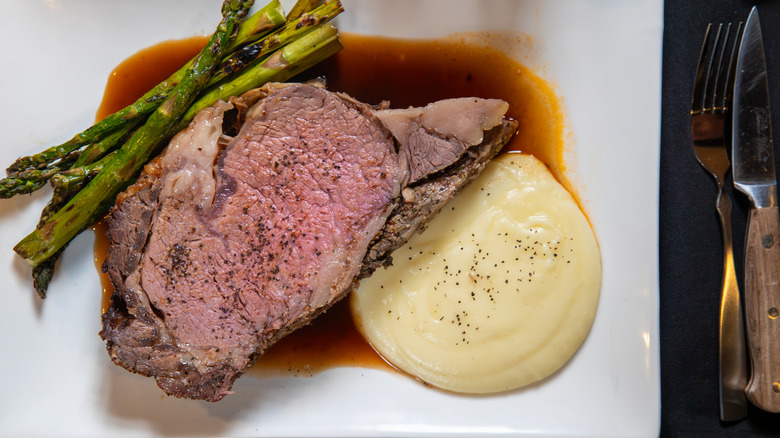
You may be wondering how the salt crust method works and, more importantly, how it might affect the flavor of your prime rib. Won't it just make it unbearably, well, salty? No, it won't. The purpose of the salt here isn't necessarily to season the meat (although it will, but only to a normal level). Rather, the salt acts as a food-safe clay, locking in moisture as the prime rib slow-roasts. You won't get much browning on the exterior, but if you're a Maillard reaction obsessive, you can always use this as the first stage in a classic reverse sear method and color your meat afterward on a grill or in a hot pan.
You'll get a more consistent cook, too. The salt crust is an insulating layer, which slows down the rate at which heat is applied to the meat itself. It also distributes heat evenly throughout the roast, helping you achieve a perfect, edge-to-edge cook without any guesswork or turning in the oven. If your oven has hot spots (and let's face it, they all do) it's a great way to avoid them affecting the quality of your food.
How to do make a salt-encrusted prime rib
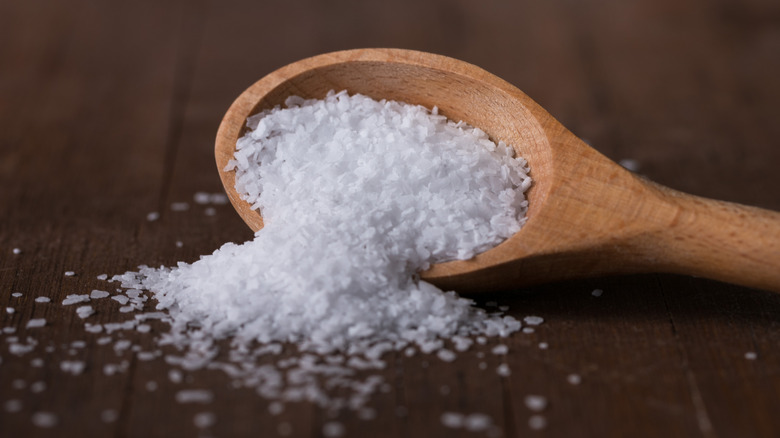
Though it might seem a little intimidating to the average home cook, making a salt crust for your prime rib is easier than you might think. The first step is finding the right salt. Kosher salt is best — it's finer than rock salt, so it's more soluble and can be molded easily to fit tightly around your roast. You'll need a lot of it, at least 3 pounds.
Start by spreading a thick, even layer of salt on a baking sheet and lay the meat on it. While your oven preheats to 450 degrees Fahrenheit, mix the rest of your kosher salt with water until it forms a clay-like consistency that's easily molded and holds its shape. Add your water gradually, so you don't accidentally create a slushy solution more useful for brining meat than cooking it.
Use the salt mixture to encase the meat, ensuring that you have a tight seal all around it, and pop it in the oven. After 15 minutes, reduce the temperature to 325 degrees Fahrenheit. Let your prime rib cook for about two hours, though the exact timing will depend on the size of the cut. To accurately gauge when your meat is finished cooking, place a thermometer in the roast before you encase it in salt so you can keep tabs on it as it cooks. Take it out of the oven when it reaches 130 degrees Fahrenheit for a perfect medium-rare roast. Let it rest for 20 minutes before you break open that salt crust and enjoy!