

What To Know Before You Deep Fry Edible Flowers
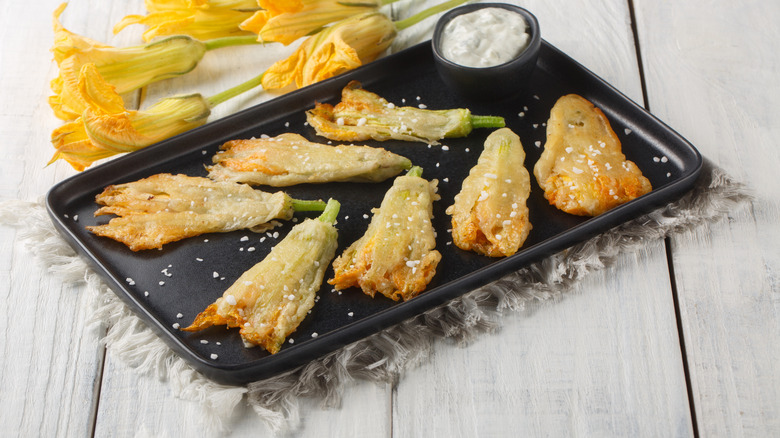
Many of us may appreciate receiving a bouquet of flowers, but it's probably not often that they end up on our dinner plates — let alone inside a deep-fried shell. While edible flowers are often used as garnishes, fried varieties are much less common in American cuisine. In reality, though, the practice is more common than you may think. So is frying flowers really worth it? The short answer is it depends on what you're looking for.
To learn more about frying flowers, we spoke with Stephanie Bonin — chef and owner of Patio Tropical — for an exclusive interview at the New York City Wine and Food Festival. Bonin revealed that fried flowers are a main component of a traditional Mexican dish: Buñuelos de Flores de Calabaza. The dish involves filling squash blossoms with a mild cheese (the type of cheese varies by recipe, with some opting for Parmesan, goat cheese, or ricotta) and then deep-frying them.
When preparing squash blossoms, Bonin recommends using a piping bag to fill the flowers with a "cheese mixture with some herbs," then dipping them in a batter before frying. For the perfect batter, Bonin suggests opting for rice starch or potato starch (which you can combine with Wondra flour for ultra-crispy fried chicken wings) plus a splash of alcohol (such as vodka) to enhance flavor. In her restaurant kitchen, she also uses CO2 with a siphon to ensure the final product is crunchy yet airy. Of course, since most home cooks don't have CO2 and other speciality equipment on hand, Bonin has an alternative. Like Jacques Pepin, who uses Wondra flour to achieve extra-crispy fried chicken, Bonin also recommends Gold Medal finely milled flour to create the perfect flower-frying batter.
Other ways to incorporate flowers into your cooking
Still, just because you can fry flowers doesn't mean you have to. Fried flowers can be delicious but, as with anything, there are trade-offs. "People like to fry things because they like the crunchiness of things," Stephanie Bonin says, but once you do, you risk losing out on the flower's natural texture and flavor. And that's not all. According to Bonin, frying your flowers at such a high temperature essentially kills its natural aromatics and organic properties.
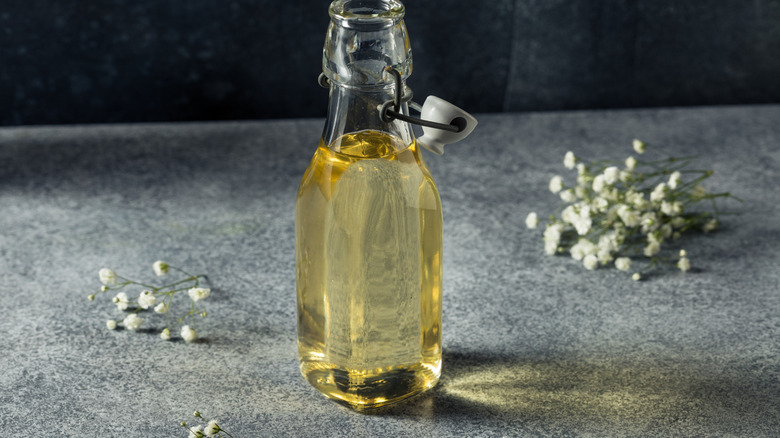
If missing out on those qualities feels like a dealbreaker, there are plenty of other ways to incorporate flowers into your cooking. And squash blossoms aren't the only flowers worth utilizing either. Bonin's personal favorite is the chive flower. "You can put [them] in a salad" or even add them to any dish that typically includes chives if you're looking to create a brighter flavor profile. Infusing flowers into a simple syrup is also one of the best ways to use edible flowers in your baking. "You can make beautiful syrups with [fresh flowers]" because of their aromatic properties, Bonin explains, pointing to elderflowers as an especially good option.
Notably, flower choice matters. Oftentimes, "people just put a flower in any dish because it looks beautiful." But there's more to it than that. Every flower has its own distinct flavor profile. Understanding what each one brings to your dish is crucial to ensuring your flavors complement (rather than compete with) one another.