

Yes, How You Roll Pie Dough Matters
We may receive a commission on purchases made from links.
Halloween is over, and that can only mean one thing — it's time to start test-baking your pies for this year's Thanksgiving feast. The deceptively simple dessert pairs fillings of all varieties with wonderfully buttery, perfectly flaky crust, and getting that crust right is fairly key to the whole success of the pie. So whether you're a seasoned pie veteran or it's your first year hosting the big family meal, it's never a bad time to get a few words of advice on your crust technique — especially when it's from a cookbook author and baking expert like Erin Jeanne McDowell, who kindly shared her knowledge with us on the perfect way to roll out your pie dough. The most important thing to keep in mind? Don't forget to shift your dough.
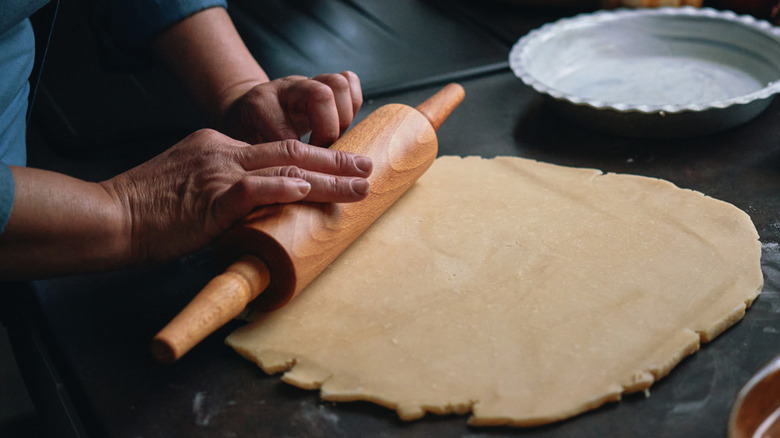
"I move my dough around constantly, even turning it over, while I'm rolling it out," McDowell shared. "If you leave it in one place and roll repeatedly, it's more prone to sticking." This way, you can maintain the same rolling motion, while still ensuring that every part of the dough is evenly rolled. Continuous movement also reduces the amount of flour you need to use to unstick your dough, McDowell pointed out, an important thing to note given that an excess of flour being added can mess with the end texture of your crust. Thankfully, this also means there's one factor you don't have to worry about — the baking expert assured us that the direction in which you roll doesn't really matter, so don't stress about causing a tough crust by somehow rolling the wrong way. Any direction should work just fine, as long as your dough is even by the end.
Expert tips for keeping your dough even
As you may have picked up on, the major goal of successfully rolling out a pie crust is ensuring it's evenly rolled out. But if that's not something that comes naturally to you, Erin Jeanne McDowell has a couple of tips for improving — one about technique, and another about the tools you use. If you're inexperienced at rolling out dough and don't know where to start, the baker says to start with your pin in the center of the dough and roll away from your body. Bring it back to the center, and this time roll toward yourself, repeating as you turn the dough. "This will feel awkward and slow at first, but is the best way to learn how to apply even pressure while rolling," McDowell explained. "Once you get used to it, you can increase the speed."
She also encourages eager pie-makers to try out different rolling pins to discover what works best for them. Rolling pins with handles are one common option, but if that's all you've ever used, maybe try a tapered French-style version (such as this Muso Wood Sapele French rolling pin) rather than a straight rolling pin to see if it helps you apply pressure more evenly. There's no one right choice, McDowell emphasized. Finally, if the pie still isn't quite up to your standards, make sure you're not making one of these common pie crust mistakes, so that you really rock the preparation of your next sweet dessert feast.