

Ruth's Chris' Trick That Grills Your Steak To Perfection Every Time
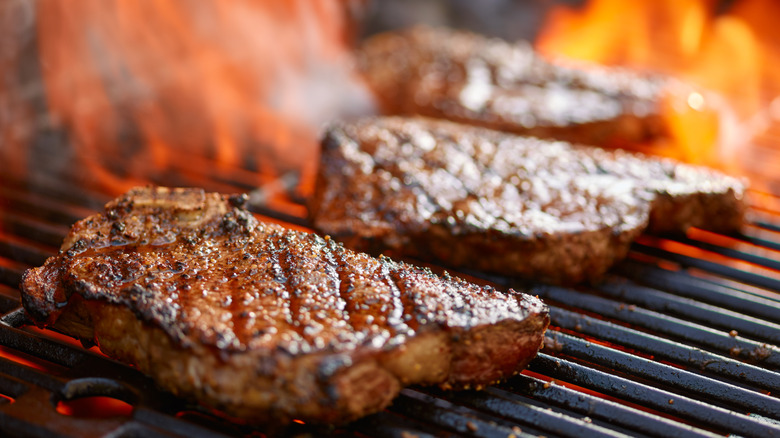
When it comes to cooking a perfect steak, there are only a few rules — and one of the most important is heat. You'll want your grill or pan at a sizzling 450-500 degrees Fahrenheit. Whether you're searing in cast iron or firing up the grill, you need that rip-roaring heat. But what if you don't have a thermometer or laser temp gauge and need to know how hot your grill is? Luckily, the steak experts at Ruth's Chris Steak House have posted a simple trick for that on its blog. Hover your hand a few inches above the grill grates, and if you can't keep it there for more than two seconds, your grill's hot enough for a perfect sear.
If you have an average-sized gas grill, preheat it for five to 10 minutes to reach 450 to 500 degrees Fahrenheit. On a charcoal grill, it should take about 20 to 30 minutes to preheat. Make sure you don't pile the charcoal too high, and keep the distance between the grill grates and the charcoal at about 3 to 6 inches apart.
And obviously, be safe doing this trick. Keep your hand off the grill grates, and hold it a few inches above them. If your grill is too hot, you can always cool it down safely and slowly by slightly closing the intake damper on a charcoal grill or turning off one of the burners on a gas grill. On a charcoal grill, keep the top vent open and adjust the bottom one halfway closed to cool things down. Grills may vary, so feel free to experiment with your damper and how it affects your charcoal.
Why heat is important: the Maillard reaction
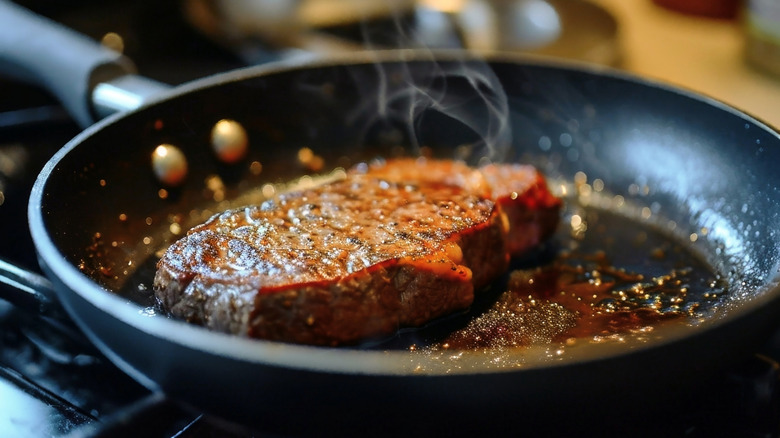
That brown color and crust on the outer layers of a steak is called the Maillard reaction, which is different from caramelization. Simply put, it is a chemical reaction where sugars and amino acids break down under heat. As the saying goes, "color is flavor," and this is where it happens. If the pan or grill isn't hot enough, or if the steak is flipped too often, you risk ending up with a gray or undercooked steak. Ideally, you want to hear a lively sizzle, flip the steak about every two to three minutes, and watch for a golden-brown color.
Ruth's Chris' blog reinforces this key bit of patience, reminding readers to "let the steak do the work." Make sure you're cooking over that same high heat you couldn't hold your hand above for more than two seconds, and give the steak time to develop deep sear marks before flipping. Then, once it's reached the desired temperature, pull it from the heat and let the steak rest for at least five to 10 minutes. This approach ensures every bite will be packed with flavor while being perfectly seared on the outside and juicy on the inside.