

The Step You Shouldn't Skip When Preparing Bacon In The Oven
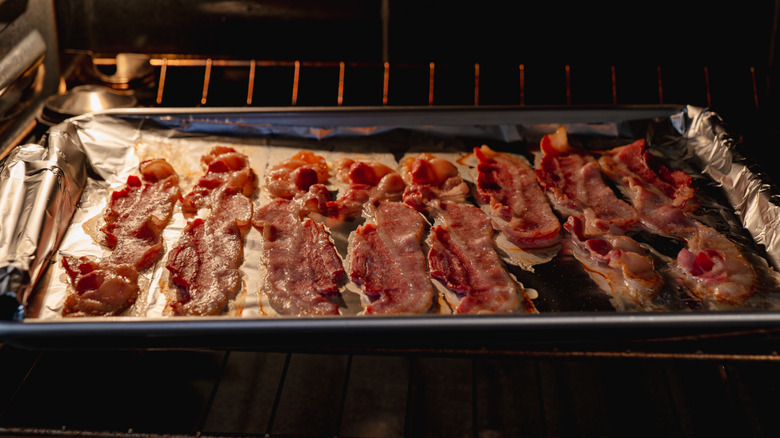
Bacon is a surprisingly versatile ingredient, which, despite its savoriness, has also found a place on the dessert table. The scientific reason behind why bacon tastes good with everything is partly due to its saltiness, which helps it to fit like a missing puzzle piece even in sweet treats and tangy bites. Most people tend to cook it in a skillet, but the oven is actually the best and easiest way to cook bacon.
Chowhound exclusively spoke with two experts to get in-depth insights on the surprising step you shouldn't skip when preparing bacon in the oven: rotating the pans. Robert Cornett, executive chef at Rancho de los Caballeros in Wickenburg, Arizona, explains that this is particularly important when working with a non-convection oven. Chris Mattera, culinary innovator at North Country Smokehouse, which you can also find on YouTube, further explains why. "Rotating the pan ... can ensure that the slices of bacon cook at roughly the same rate across their whole length," he shares. "Unrotated pans can cause the bacon to cook unevenly due to temperature variation throughout the oven."
The reason you don't need to observe the same method if you have a convection oven is that it's equipped with a fan that distributes enough air in the appliance. While it can turn into an easier task from the get-go, it will require more cleanup, as the air will cause bacon grease to spatter all over the oven. When you can, choose a non-convection oven as your cooking setup.
How to rotate your pan like a pro
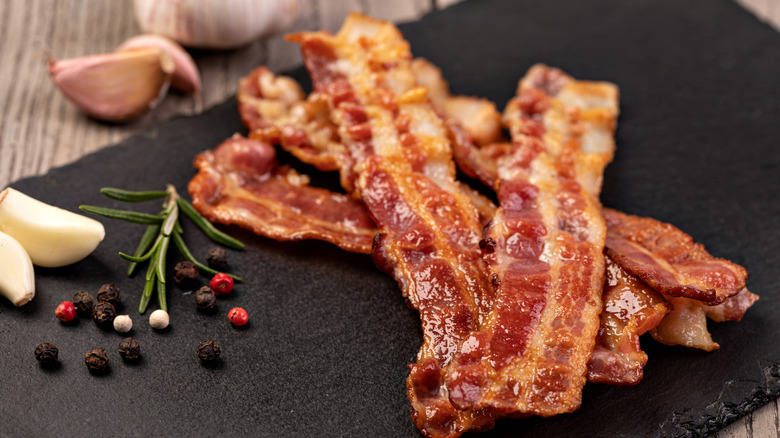
"Bacon can be rotated about halfway through the cook time, around the six-minute mark," Chris Mattera advises. "For North Country Smokehouse bacon, I usually recommend 12 minutes at 375 degrees." If you're following the same procedure, make sure to take thickness into consideration, as not all bacon slices should be treated equally. For thicker-cut slices, the sweet spot is between 15 and 20 minutes, especially if you want a crispier finish, though you can get by with less cooking time if you want a tender bite. The kind of pan should also be taken into account. Mattera notes that darker-colored pans can cook bacon faster, light-colored ones slower, and thicker ones produce a more even result.
Another noteworthy tip is not to leave the bacon unattended — not if you want everything to cook evenly and equally. As such, have tongs ready so you can easily flip the slices and adjust the ones that seem to be cooking too fast or too slowly. And when the oven beeps to signal that it's done, don't get too excited. "[Don't] pull [it] before you think it's done and let it finish in its fat," Robert Cornett recommends. This helpful tip when cooking bacon in the oven ensures that you don't skimp on flavor, as the juices are packed with that deliciousness we all know and love.