

The Underrated Cut Of Bacon Butchers Wish More People Would Ask For
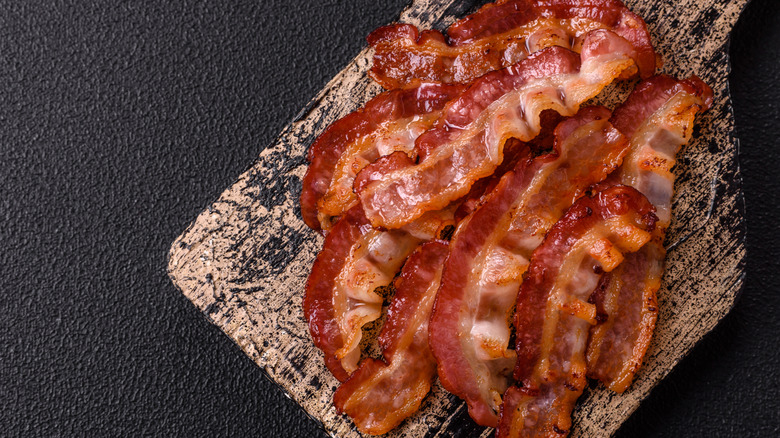
Bacon. If you love the salty, crispy slices of pork, just reading the word can make you salivate. It may not come as a surprise, but there's a scientific reason bacon tastes so good, and it has to do with how many flavor receptors it hits on your tongue. When trying to get the perfect crunchy, slightly chewy pieces at home, there may be some mistakes that are ruining your bacon. You should know, however, that you don't have to just buy pre-packaged bacon cut into strips. You can get a whole slab of bacon from the butcher shop, and maybe you should even think about getting it with the rind (skin) still attached.
For some help on the subject, we reached out to an expert for a Chowhound exclusive. Koji Fujioka, butchery manager at The Local Butcher Shop in Berkeley, California, knows his way around a knife and cutting board. Fujioka tells us, "The term 'bacon' has become synonymous with smoked pork belly, which is a fully cooked product that is then sliced into the fatty marbled strips you find sold in most grocery stores and supermarkets." However, you can get the whole slab of smoked pork belly before it's sliced.
Slab bacon is similar to a pancetta, but the pancetta isn't smoked. Fujioka continues, "Slab bacon is a bit more versatile than pre-sliced bacon, because you can cut or portion it as you please and you're not confined to the predetermined thinness of sliced bacon." Cut into larger pieces, slab bacon can hold up much better than sliced bacon when cooked for longer periods of time, often with liquid ingredients.
Expert tips on how to use slab bacon and what to do with the rind
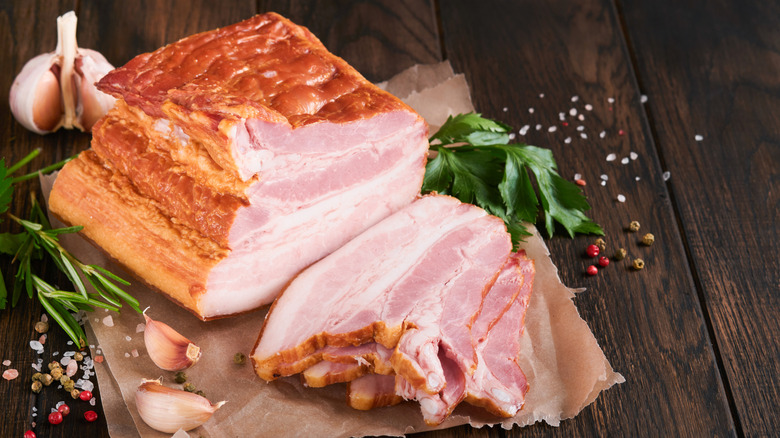
Wondering what to do with slab bacon? Koji Fujioka has a range of suggestions. "It can be used as a wonderful addition to a pot of home cooked beans, braised greens, savory pasta, casseroles, etc. That being said, it can be difficult to slice uniformly at home, especially if you like your bacon cut thin." So, if you're only using it for fried bacon, you'll need to enjoy it thick. To use it in other dishes, you can cut it into chunks and cook it in olive oil to render the fat, then add aromatics and other ingredients to cook down. For baked beans, you can render the chunks, then toss them into your bean mixture as it cooks.
Fujioka says bacon is usually made with the skin or rind still connected. "This protects the fatty outside layer of the belly as it is cured, smoked, and cooked through." While it may be difficult to find in conventional grocery stores, you should be able to order slab, rind-on bacon from your local butcher. He doesn't recommend trying to make cracklings or chicharrones from slab bacon skin because it's already cooked. "It will just become extremely hard and hurt your teeth," he notes. But it's a great way to impart extra smoky flavor in stews and soups.
"The rind can usually be removed just by slowly pulling it off like Velcro," Fujioka says. "However, if it's holding firm, it can be carefully removed with a knife." If you're doing it at home, he suggests first cutting the part of bacon you intend to use, then carefully removing the skin from the smaller pieces. "It'll be safer and more manageable this way. Then again, your butcher should be able to do that for you (we certainly are happy to do so)."