

What It Actually Means When Your Meat Is Labeled 'Produced In USA'
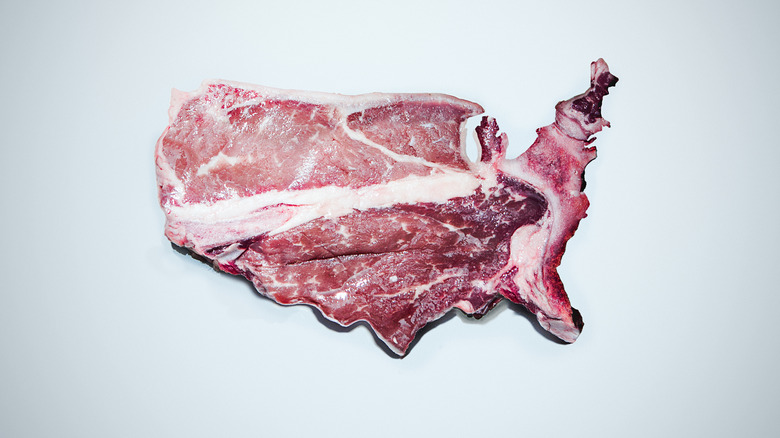
We're all trying to be more mindful about what we eat. What goes into our food, where it comes from — and meat's no different. One way to tell is the "Product of the U.S.A." label you might see on the meat's packaging. For anyone worried about imported meats due to fears of food safety and even an environmental impact, this is a reassuring marker that the meat you've chosen was (or at least should have been) raised and produced in the good ol' United States of America. Surprisingly, while it's certainly helpful to have this disclosure, it may not fully mean what one might think. As reassuring as it might be to see a Country of Origin Label, the unfortunate truth is the "...of the U.S.A" variety isn't what it seems, as there are loopholes in it.
Although the "product of the U.S.A." label is voluntary, the current law behind it is a bit loose, as the store-bought meat with that label can be born, raised, and slaughtered outside of the U.S, but as long as its packaging takes place within its borders, it's perfectly fine to have it. It may not seem like an issue, but it's caused domestic farmers distress because imported meat is usually cheaper for corporations to purchase. To address this, the Food Safety and Inspection Service introduced a 2024 amendment requiring any meat, poultry, and eggs labeled as a product of the U.S.A. to be born, raised, slaughtered, and packaged in the United States. This way, there's more consumer transparency and domestic farmers get a fair shake against international competitors. Unfortunately, although it's effective as of May 2024, producers aren't expected to be fully compliant until 2026.
'Produced in USA' is among the many misleading food labels out there
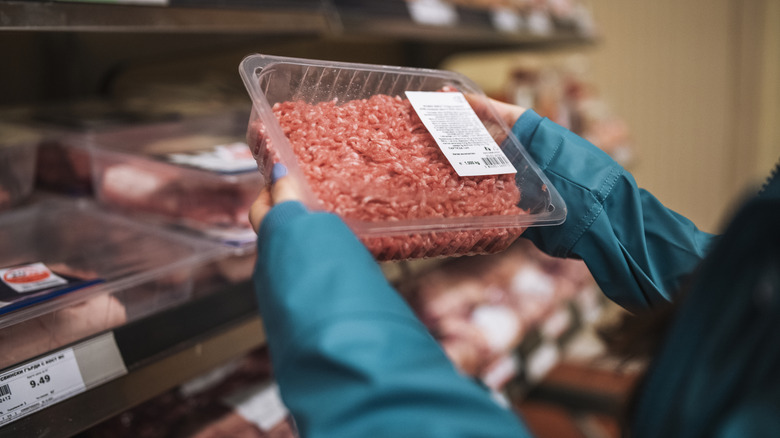
As misleading as the "...in the U.S.A." label can be, it's far from the only problematic one when it comes to red flag food labels in the grocery store. In a similar sense, while food labels may want you to think that "naturally flavored" means getting a healthier alternative with no chemical additives, the FDA hasn't actually defined the term "natural." It just has to be originally, naturally sourced from plants or animals. Commonly, to make those natural flavors, manufacturers can create chemical enzymes from those natural sources that are highly processed with "incidental additives" like emulsifiers. Of course, these labels lead to consumer confusion, especially when the definition of "organic" gets into the mix (which basically just confirms that the food was organically farmed, avoiding some farming additives and processes).
We'll have to wait until 2026 to see how effective the new "Product of the U.S.A." regulations will be. For the moment, consumers who want to do more outside of observing food labels have options. The best way is to support your local producers by buying from them directly, either from their establishment or a farmer's market. To help, the United States Department of Agriculture and the National Sustainable Agriculture Coalition have guides online to find local farms, ranches, and fisheries for anyone wanting to take the guesswork out of where their meat is coming from.