

The 'Didn't Know' Kitchen Cleaning Hack That Helps You Declutter
Keeping your kitchen clean, organized, and clutter-free often seems like an uphill battle. From mismatched food containers taking up valuable cabinet space to open packs of snacks and cereal disappearing into the shadows of your pantry, it may feel impossible to declutter this space completely. Fortunately, there are plenty of kitchen decluttering guidelines and tips you can follow to break this process down into smaller, more manageable tasks you can accomplish over time.
To make a lot of progress very quickly and keep the organizational momentum going, the first thing to do when decluttering your kitchen is getting rid of duplicate items and also following the "didn't know" rule. Created as an organizational challenge by professional organizers Joshua Fields Millburn and Ryan Nicodemus (better known as The Minimalists), the "didn't know" rule encourages you to go through all of the cabinets and drawers in your kitchen and pull out anything you didn't know or had forgotten that you had.
The idea is to then toss, donate, or give away these items rather than trying to create another dedicated storage space for them. After all, you've gone this long without feeling a burning need to use that veggie spiralizer, French press, or fancy omelet pan — odds are, it just doesn't fit into the way you use your kitchen. Letting go of these items frees up space in your kitchen to store more of the things you use daily, such as tea towels, new baking sheets, or a customized first aid kit to make your kitchen safer.
Keeping your kitchen decluttered (almost) permanently
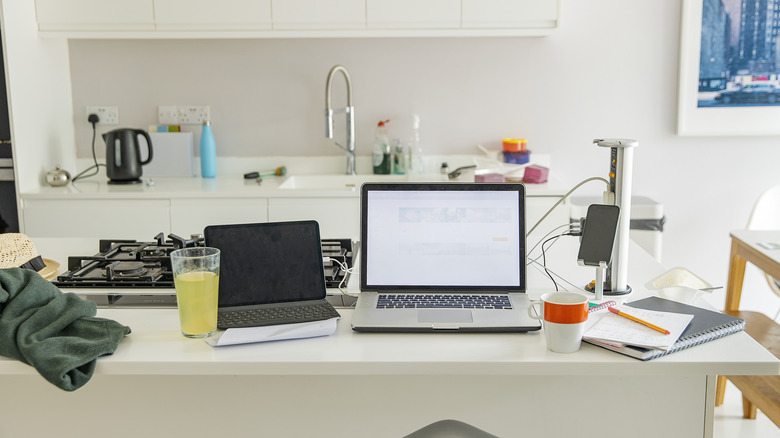
The "didn't know" rule doesn't just apply to duplicate items or unused Christmas gifts from well-meaning extended family members, but also to things that don't really belong in the kitchen to begin with. Kitchens often end up as catch-all spaces for everything from pens and legal pads to errant power tools, shoes and coats, and even electronic devices. Though you likely won't discard or donate any of these items, none of them really have much to do with the act of cooking, eating, or celebrating and should be stored somewhere else.
If your home is relatively small, and some of these things have to live in the kitchen, they should have a dedicated space that doesn't interfere with the functionality of the space. For instance, if you like to keep a legal pad and pen on hand to make grocery lists and write down recipes, try attaching magnets to both of them and placing them on your fridge. If your kids do homework in the kitchen and their backpacks have to be in there, install hooks for them to use when their work is finished so the bags don't become tripping hazards.
Sometimes implementing the "didn't know" rule may also help you find items you thought you'd lost, or discover a gadget you'd been planning to purchase. In these cases, it's more than okay to keep these things — provided, of course, you store them somewhere they're easy to access, so you remember to use them.