

The Native American Dish That Became A Staple During The Great Depression
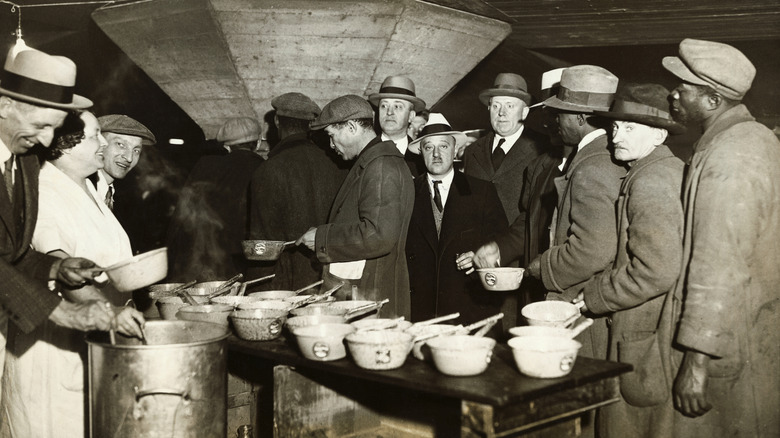
In late October 1929, the U.S. stock market crashed, turning a summer of recession into the years-long Great Depression. The next year, severe droughts would hit the Midwest and last for around a decade, exacerbating the economic catastrophe. The hedonistic luxury of the Roaring Twenties was gone, and soon, almost 25% of the U.S. population would be out of work and in the soup kitchen line. Whether relying on such aid or cooking for their families at home, the population had to employ economy in their meals and creativity with their ingredients to get by. These hard times gave rise to the necessity of simple staples, like creamed chipped beef that was made with meat scraps, dandelion salad collected from front yards, an apple pie that didn't contain apples, and a filling cornmeal-and-water mush.
Although the era gave birth to many budget recipes that made use of what little was available, corn mush was hardly a new invention. Maize had been a part of culinary cultures all over the world ever since 15th-century colonizers brought seeds back to Spain, but indigenous people from all over North and South America had been cultivating corn for thousands of years – and making mush for just as long. Mush is made by grinding dried corn into meal and boiling the cornmeal with water or milk to make a hearty, nourishing porridge that's similar to grits and polenta but with a finer texture. Its simplicity, affordability, and nutrition made it a natural choice for sustaining a suffering population through the Great Depression's economic turmoil.
Cornmeal mush has been satisfying stomachs for thousands of years
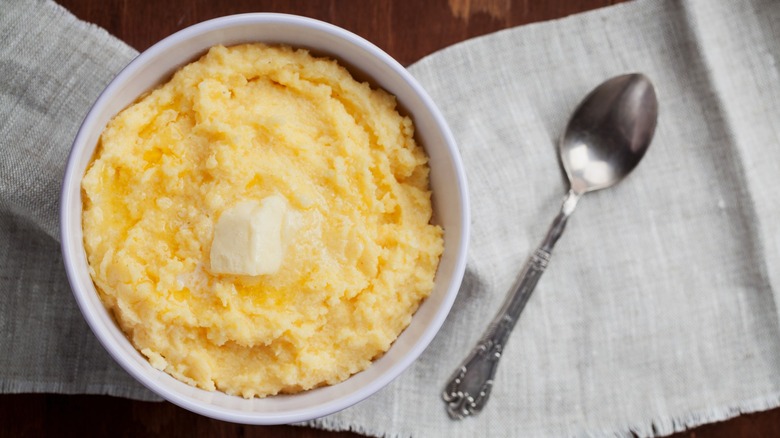
Around 9,000 years ago, the indigenous peoples of Mesoamerica likely domesticated maize from a grass called teosinte. It quickly became a critical crop, spreading through trade routes and migration to arrive in what is now the Southwestern U.S. around 4,000 years ago, archaeologists estimate, and reaching the Northeastern U.S. more than 2,000 years ago. Many indigenous communities continue to see maize as something more than mere food; it is an offering in prayer, a ceremonial object, and for some — like the Hopi Tribe of northern Arizona — even a sentient being. Of course, it is also serious sustenance and a ready source of fiber, vitamin A, and, when processed correctly, the B vitamin niacin. Dried corn, too, can keep for over a decade if stored correctly.
Fast forward to the 1930s, and Midwestern farmers had planted large swaths of corn in an attempt to cover postwar debts. However, corn prices dropped extraordinarily low (as little as 8 cents for a bushel). While this meant bankruptcy for many farmers, it also meant cheap corn wasn't hard to come by in certain areas. So when people plagued by economic depression were searching for foods that could fill their families without spoiling or breaking the bank, corn mush became an essential food of the Great Depression. The simplest version of the meal slowly boils cornmeal in milk or water until it reaches the desired thickness, but corn mush was also easy to enhance without much cost or effort. A little bit of sugar, cream, molasses, or maple syrup could be added for sweetness, and chilled mush could be sliced up and fried.