

How Much Pressure Should You Really Use When Tamping Espresso?
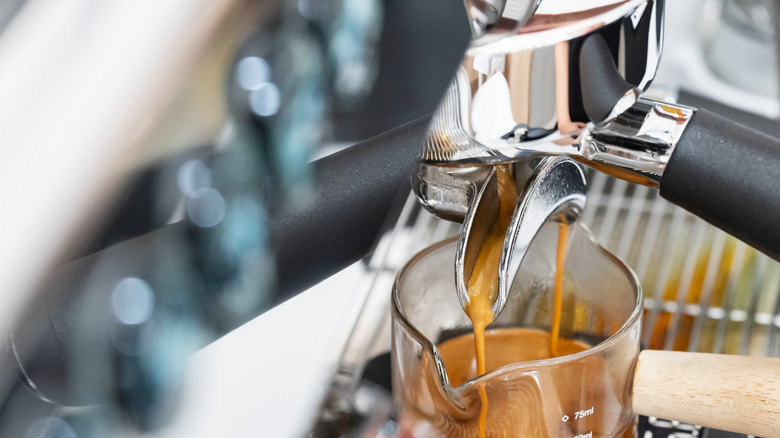
Gone are the days of tasteless instant grounds and watery filter coffee. Thanks to a wide range of machines available to the at-home barista, the coffee you can make in the comfort of your kitchen is better than ever before. For those of you who've invested in a home espresso machine, you should know how to get the very best coffee out of it and how to keep your machine in tip-top condition. One way to accomplish both is ensuring you use the correct technique when making your shot, particularly when tamping it.
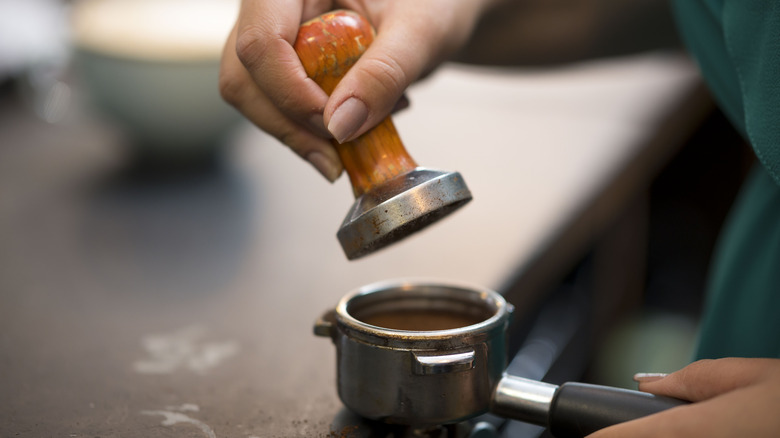
If you didn't know, tamping is a sometimes skipped step (at least by home baristas) in the espresso making process that involves compressing the coffee grounds inside your espresso head to facilitate even extraction and a silky-smooth coffee. It's often hard to know how much pressure to use when tamping; too much and you get bitter, under-extracted coffee while too little gives you a watery, weak result. To find out exactly how much pressure to use, we spoke to Matt Woodburn-Simmonds, ex-barista and founder of Home Coffee Expert.
"Generally, people suggest around 20 pounds of pressure," he told us. This helps ensure "even water flow and [prevents] 'channelling,' where water finds little paths through the puck leading to uneven extraction." The consistency with which you tamp is more important than the exact pressure you use, though. "If you use the same pressure every time then you can adjust other factors, such as grind size and extraction time, to nail the flavor," Woodburn-Simmonds said.
Why you should never tamp a moka pot
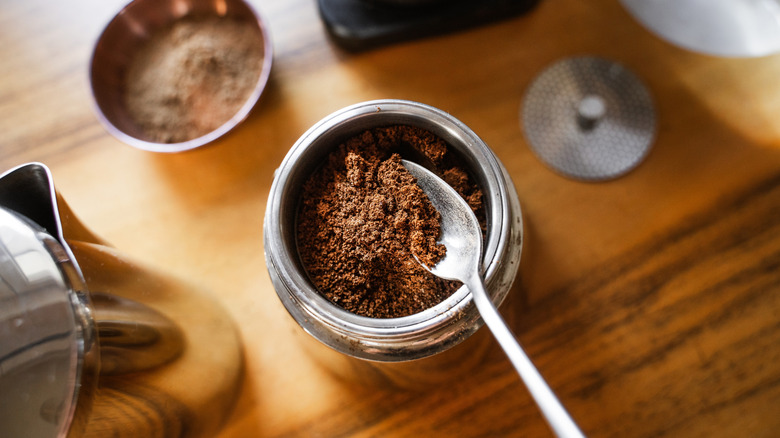
20 pounds of pressure is the golden zone when it comes to tamping down your espresso shot, but what if you're making espresso in a moka pot? This nifty little Italian invention is a great way to get espresso-style coffee shots that are perfect for a creamy at-home latte without the rigamarole of a full on espresso machine — and, importantly, at a much lower price point. Well, if you're using a moka pot to make espresso, Matt Woodburn-Simmonds told us not to tamp your grounds at all. Just "add the lose grounds and give it a little shake to get a nice flat surface."
Espresso machines and moka pots might produce a similar product, but the way they work isn't exactly comparable. Sure, they both extract shots by combining water, heat, coffee, and pressure, but there are differences in how much pressure is used. "Moka pots aren't built for high pressure," Woodburn-Simmonds told us. "They work at around 2 bar compared to the 8 [or] 9 bar for espresso extraction." Tamping the grounds in a moka pot doesn't just give you a bad coffee — you might end up with no coffee at all! "If you tamp the grounds the moka pot either won't generate enough pressure to push the water through the grounds, or it would extract too slow and the coffee would be extremely bitter," Woodburn-Simmonds said.
Why home espresso machines need just as much tamping as their professional counterparts
You might assume a home espresso machine operates at a lower pressure than one of it's more powerful professional counterparts. As such, you might also think you need to apply a different degree of pressure when tamping. You'd be mistaken; many home machines put out pressure equivalent to a pro-level machine. As Matt Woodburn-Simmonds explained: "If you have something like the Breville Barista Pro or Gaggia Pro Evo, then you want to tamp to the same pressure as a professional would as those machines have pumps to generate a similar pressure to professional-grade machines." These machines operate closer to the 8 to 9 bar standard to produce the optimum extraction of coffee from the grounds.
Finally, make sure your tamping technique is up to scratch: Use a sturdy tamper that fits your espresso basket, keep your wrist straight, and apply a firm, even pressure. This technique is simple, but it helps you achieve a more consistent result than simply jamming your tamper down hard into your coffee. Et voilà! Perfectly tamped coffee every single time.