

The Absolutely Wild Aldi Banana Scandal We Still Think About
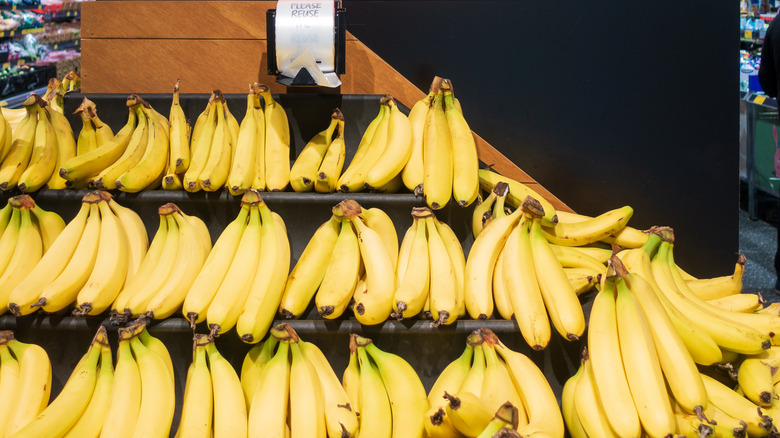
Aldi employees in Germany have probably learned to expect the unexpected with any banana shipment they receive. Why? Because what should be routine produce deliveries have repeatedly turned into major drug busts, creating one of the most bizarre patterns in retail history. Over the past decade, multiple Aldi locations have discovered massive cocaine shipments hidden among their bananas ... not once, not twice, but enough times that it has become almost predictable.
Aldi might be the cheapest grocery store in America on average, but that's not enough to convince every shopper out there. In fact, some people deliberately avoid Aldi for a number of valid reasons, including limited inventory and rushed checkout lines. But this wild story is more than enough reason to look at the grocery chain with raised eyebrows.
The timeline reads like a criminal comedy of errors. In January 2014, police found nearly 309 pounds of cocaine at five Aldi stores in Berlin (the city's biggest cocaine discovery since 1999). The following year brought an even larger haul: more than 660 pounds worth nearly $17 million found in Berlin-area Aldi stores in May 2015. The pattern continued into 2019 with the most staggering discovery yet, more than half a ton of cocaine worth about $28 million found at six Aldi branches in Rostock, plus a logistics center in Jarmen.
Why Aldi's drug scandal became a recurring issue

Bananas aren't chosen at random; they're a clever method of smuggling goods, at least until they aren't. Spanish authorities have seized similarly shocking shipments of cocaine concealed within banana consignments. Law enforcement once seized nearly 10.5 tons of cocaine in banana containers from Ecuador, showing how this smuggling technique has a global reach beyond Germany. A likely reason for this affinity is that bananas have unique temperature-controlled shipping requirements that make it difficult for border patrols to thoroughly inspect cargo without risking damaging the whole shipment. Along with the perishable nature of bananas comes time pressure that discourages thorough inspection.
Each incident followed an eerily similar pattern: staff opening routine banana deliveries in the morning, immediate police involvement, and investigations tracing back to South America. The consistency suggests these were not isolated criminal enterprises, but recurring failures in the same type of operation. What seems bizarre about these instances, however, is not the fact that cocaine was concealed within bananas, as this regularly occurs, but the fact that the shipments were actually delivered to retail stores. Despite all of this, though, Aldi has shown no signs of slowing down — in fact, it's set for an expansion tear in 2025. This also isn't the retailer's only scandal of a great magnitude. In 2017, Aldi suffered a seafood scandal involving the inhuman treatment of North Korean laborers abroad. Thankfully, unlike the recurring banana scandal, it seems that was an isolated event.