

How Any Fast Food Drive-Thru Line Can Indicate Avoidable Red Flags
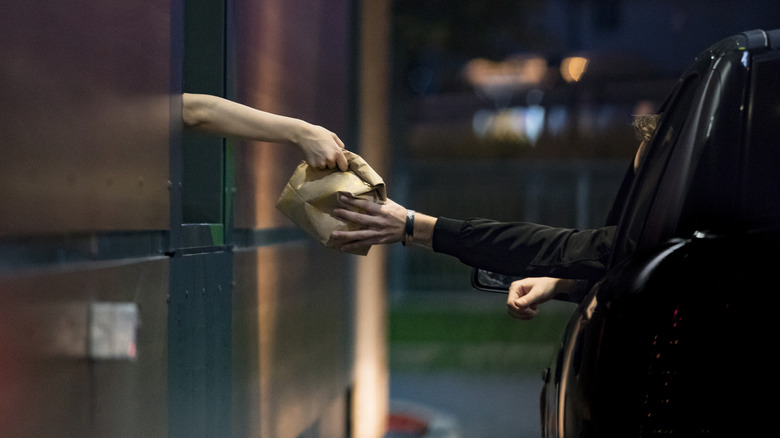
One of the more difficult aspects of judging the quality of a fast food restaurant chain can be the number of locations it operates. One location might have a 5-star rating while another one 20 miles away might have a 2.5-star rating. You never quite know what you're going to get until you've been there yourself.
That said, there are some fast food red flags that might indicate when you should avoid one location altogether — some of which you'll see before you even walk into the door. A posted poor health rating, confusing drive-thru menu, and a tourist trap vibe are a few examples. But probably the biggest giveaway is a snail-paced drive-thru line. After all, the whole idea of fast food is that it's, well, fast. A well-functioning drive-thru fulfills the very idea of the experience an on-the-go customer expects.
Customers just don't have the patience to wait 10 minutes for a cheeseburger and fries, and the data tends to back that idea. According to data from CivicScience, three-quarters of respondents surveyed expect to receive their order within five minutes or less. Typically, a slow drive-thru is just a symptom of other deeper issues within the fast food spot — one of which might be staffing. When a restaurant has one person working the drive-thru and only two in the kitchen, it can be difficult to meet a flurry of orders at peak hours.
The slowest drive-thru time goes to...
Long lines might not always indicate slow service, as the best chains have perfected the art of moving cars through the queue. But just, in general, bad restaurants and repeat offenders are pretty easy to spot — and that's what keeps customers from coming back, instead opting to write poor reviews on Google and give an eatery a 1-star rating.
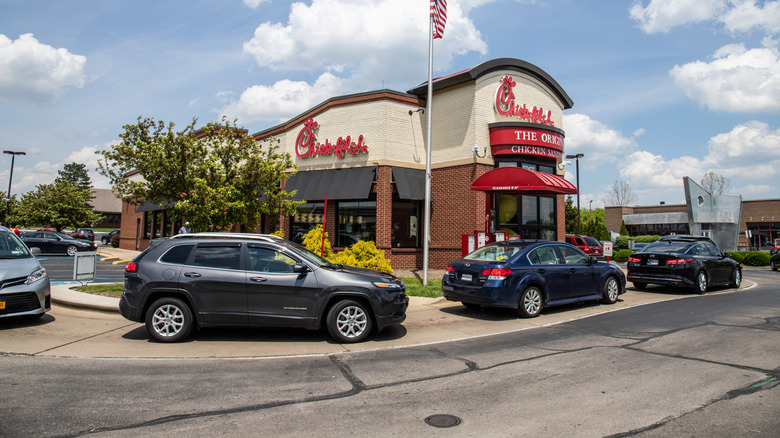
When it comes to real-life examples of slow drive-thrus, a 2022 survey (PDF) conducted by QSR Magazine provides some great insight. While Chick-fil-A might be one of the more popular fast food restaurants, it's not necessarily speedy. The chain had the slowest total time (a little over eight minutes) in the QSR report, with "total time" being defined as "total amount of time the shopper spent in the drive-thru. Time starts when shopper enters the drive-thru and ends once they exit." The report also shows that Chick-fil-A is a bit of a victim of its own success, typically having the busiest drive-thrus. This means, even if waiting for your food takes more time, Chick-fil-A is actually incredibly efficient because it averaged the most cars in line at any given time. The other top five slow performers included Wendy's, McDonald's, Burger King, and Arby's. On the flip side, the fastest average total time went to KFC at just over five minutes.
Like we've said, all of this can vary depending on location. One spot might be understaffed with a painfully slow drive-thru line, while another spot might be well-staffed and send out orders like a well-oiled machine. You just never know until you've been there. But if you keep experiencing slow drive-thru times at a fast food chain, you can be sure there is some dysfunction and inefficiency in place — and we would advise you to go somewhere else.