

This Is How Many Peanuts It Takes To Make One Jar Of Peanut Butter
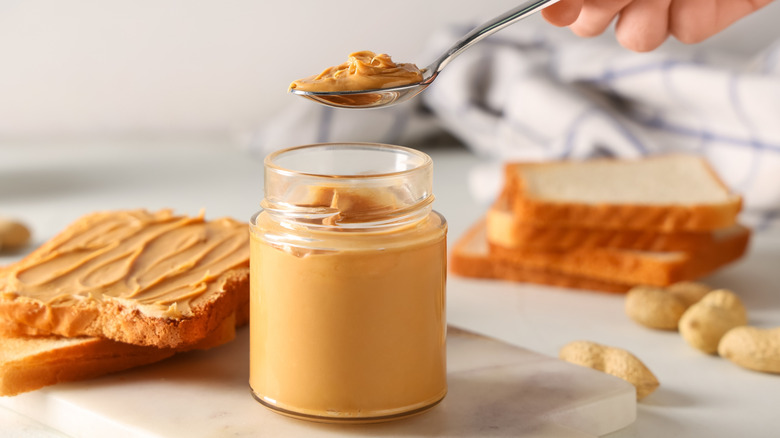
Have you ever stopped to wonder how many peanuts it takes to make a jar of your favorite peanut butter, a mandatory staple in your pantry? Probably not. But if we've successfully piqued your interest in finding out, you're in the right place. As standard, a 12-ounce jar of peanut butter typically calls for 540 peanuts to be harvested, shelled, processed, ground up, and packaged. That number, however, is not necessarily set in stone, with some lower estimates reporting approximately 405 peanuts per 12-ounce jar. After all, there are different types of peanuts, and the most common varieties used to make peanut butter are Virginia, Spanish, and Valencia peanuts. Not only does the choice of peanut impact the final taste and nutritional profile of a jar of peanut butter, but since there is variation in the size of peanuts, the final count per jar is bound to vary.
Virginia peanuts are usually larger in size and have the most oil of the three. It's the favorable choice for a smooth and creamy spread. Spanish peanuts have a higher protein content and are naturally sweeter and smaller. They also offer a nice texture, especially for those who enjoy some crunch as a contrast to smooth peanut butter. Valencia peanuts have a notably milder flavor profile compared to the other two and are also the smallest of them all. To qualify as "peanut butter" in the United States, the peanut content of every jar should be at least 90%. The remaining 10% is where the red flags emerge on a jar's ingredient list. As a general guide when shopping for peanut butter, the shorter and simpler the ingredient list, the better.
The history and evolution of peanut butter
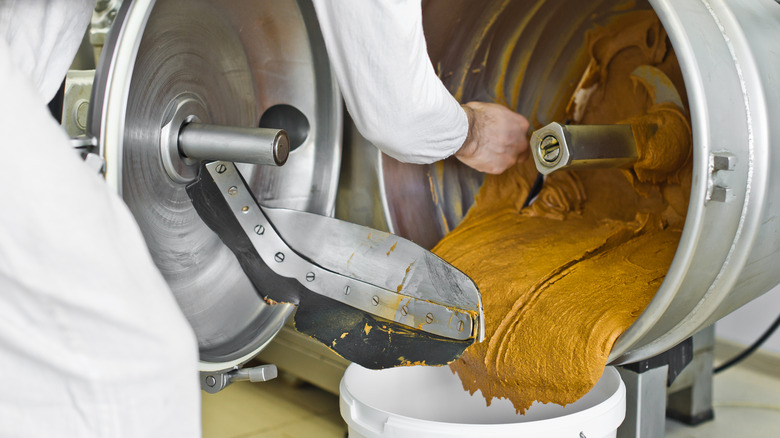
Whether you're spreading it on toast and sandwiches, or enjoying spoonfuls straight out of the jar, peanut butter is one of those condiments that are deeply ingrained in our contemporary culinary culture. In fact, different countries have their own iterations of peanut butter, like Haiti's spicy spread, Mexico's crema de cacahuate, China's savory hua sheng jiang, and many more. Peanut butter is also anything but a modern-day invention. In fact, according to archeological evidence discovered in the region, it is believed that the ancient Incan communities of South America were the first to grind peanuts into butter. Clearly, the wisdom of these communities was far ahead of the curve, as the peanut butter as we know and love today didn't make its grand debut, or rather, its reintroduction to society, until 1904 at the St. Louis World Fair.
In 1895, however, cereal mogul Dr. John Harvey Kellogg had filed a patent for a food compound that entailed boiling nuts and grinding them into paste to use as a food supplement for medical patients. Both almonds and peanuts were experimented with, and peanuts emerged victorious in the flavor and price departments. Over time, as technology advanced, more innovators and brands started lining the shelves with peanut butter. Peanut butter also became a coveted staple during both World Wars as a vital food source.
Now, we are spoiled for choice with a number of brands, and we've ranked the popular peanut butters to buy and which to avoid. So, the next time you're perusing the grocery aisles for a jar of peanut butter made from hundreds of nuts, your choice is ultimately a result of centuries of ingenuity and innovation, some driven by need, and some by pure curiosity.