

What You Need To Know Before You Swap Out Mushrooms For Extra Veggies In Your Stir-Fry
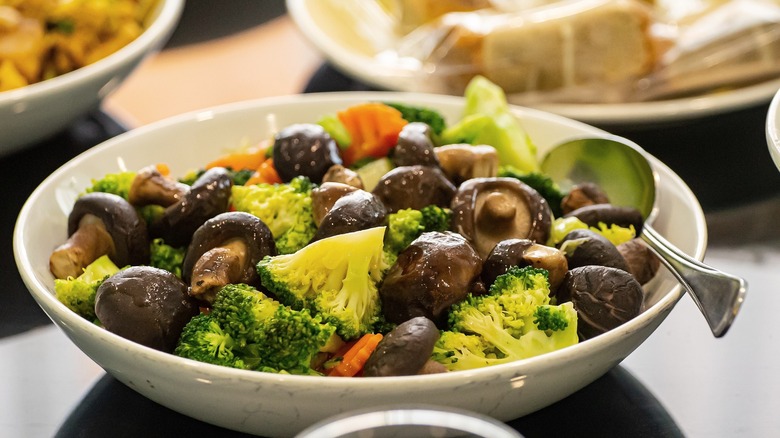
Mushrooms aren't for everyone, which can make cooking a little tricky since they go into a ton of different recipes. You can use different substitutes for mushrooms; ingredients like tempeh and eggplant can convincingly replicate the texture of a mushroom when cooked right, so you can still enjoy dishes like stews and stir-fries sans fungi. However, as the Leung family, creators of the blog The Woks of Life (@thewoksoflife on Instagram), shared exclusively with Chowhound, there's no real replacement for mushrooms in a stir-fry, at least flavor-wise, even if you go with a popular substitute like zucchini.
"If the mushrooms are a key element to the dish (used as a main source of umami in a meatless dish, for instance), zucchini definitely wouldn't stand in for the mushrooms," they told us. "However, if mushrooms are just one veggie element in a mixed vegetable stir-fry, you can get away with substituting another vegetable like zucchini."
A lot of this has to do with the wide gap in glutamic acid — an amino acid responsible for that umami flavor in different foods — between mushrooms and zucchini. The glutamic acid content in mushrooms is considered high, ranging from around 18 to 25 milligrams per 100 grams, depending on the species. Zucchini, on the other hand, has roughly a third of that amount, measuring in at around 6 to 7 milligrams per 100 grams. While this isn't the only compound that makes a flavor difference between the two, it does play a major role in why swapping out mushrooms for zucchini can significantly impact the taste of your stir-fry.
Why you should still try making the switch
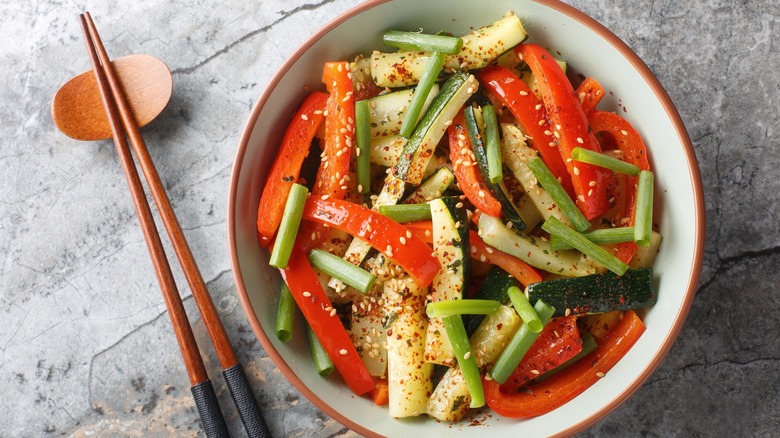
The Leung family pointed out that "stir-fry" isn't a dish, per se, but a cooking technique; therefore, you can include whatever vegetables you want in your recipe. Just because a recipe calls for mushrooms, it doesn't mean that going without them breaks tradition — in fact, the Leungs say there aren't any traditional ingredients for stir-fry in the first place. If you want more veggies in your stir-fry, there's nothing stopping you; what matters more is how you cook them.
"The thing to know is how to slice/prepare the vegetables and the order in which to add them to the stir-fry, based on how long they take to cook, so that every individual vegetable is perfectly done in the final dish," they explained. Veggies that take a longer time to cook, such as carrots and cauliflower, can go in earlier, while faster-cooking vegetables like bean sprouts can follow later. Missing out on this detail is one of the more common mistakes people make when stir-frying veggies, so make sure you plan out the cooking order ahead of time.
Prep can also play a crucial role in your vegetable stir-fry. Longer-cooking vegetables, such as celery and broccoli, for example, can benefit from pre-blanching, the Leung family shared. For zucchini specifically, they recommend salting it for around 20 to 30 minutes before cooking. This draws out some of the excess water content, allowing the zucchini to stay a little firmer in the pan. You'll also want to use high heat when cooking your zucchini.