

The Sneaky Way Hotels Know If You Use The Minibar
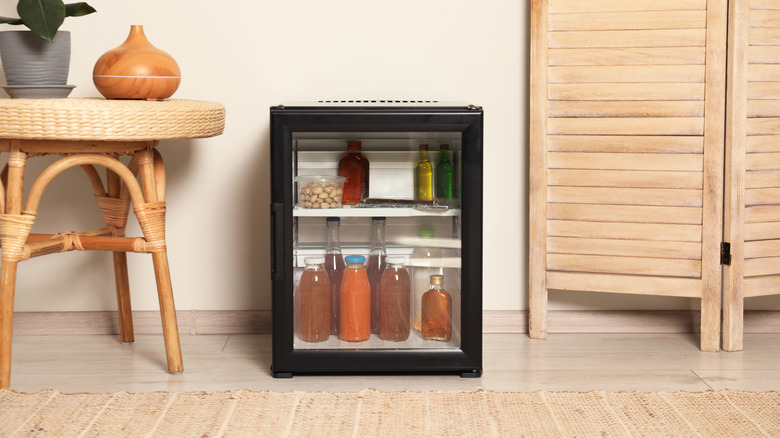
Few things compare to kicking back in a hotel room after a flight or drive to your destination. Fewer still compare to enhancing it with a snack or a classic cocktail — and hotels are well aware of this, leading some to place bottles of water and minibars in each room. This is a long-standing strategy that not only offers guests a certain level of hospitality, but also helps increase hotel profits. But how does an establishment keep track of anyone taking anything from the minibar? Simply put, sensors are utilized throughout the interior to detect when guests reach into the minibar. As impressive as the technology implemented is, those same sensors could lead to guests being falsely charged even though they never actually took anything inside.
As sneaky as it may be, manufacturers employ a few technologies to let hotels know if you used the minibar without ever entering your room. Among the more common kinds, many use microswitches, signified by black pads or tabs on or around the items, that sense when something is placed in and removed from the minibar. Infrared and RFID sensors also serve a similar purpose, as they will send a signal to the proper accounting portal when the beam is broken. Others use a magnet system that sets off a timer, the limit of which can be preset by the hotel management, when an item is lifted from the minibar. This allows guests to grab something of interest and decide if they want it without being charged immediately.
Minibars are convenient, but there are plenty of alternatives
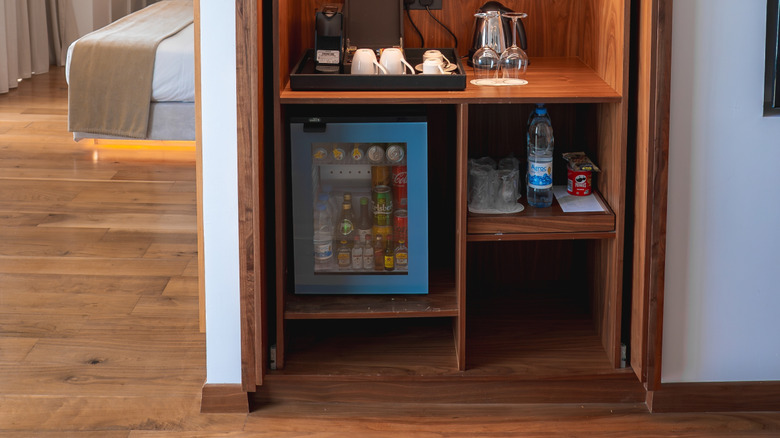
As impressive as the minibar mechanisms are, none are perfect, and there is a chance that guests may be incorrectly charged for minibar items they never took or consumed. Some reasons for this include faulty sensors or an item not being returned within a sensor's time limit. Additionally, guests may simply remove items from the minibar to make room for personal food and beverages. Though it's not guaranteed, any false charges could be disputed by speaking with a hotel representative, escalating it to corporate, or contacting one's financial institution. However, the best courses of action could be to seek out hotels without a minibar, ones that include a complimentary minibar like the Hyatt-affiliated Andaz chain, or just avoid using it at all — even if those restaurant leftovers are worth taking back to the room.
As highly accessible and well-stocked with snacks and drinks as they can be, taking advantage of a minibar's convenience can be very costly. Depending on the hotel, a small bottle of spirits could run someone over twice what they should be charged; while the upcharge isn't usually too drastic for snacks and non-alcoholic beverages, there's still a notable price difference present, even if it's by only a few dollars. Everyone is certainly entitled to their own decisions, but there are better options at a similar cost: a good meal and groceries are often only a delivery app away, and a solid cocktail could be found at the bar downstairs — especially if where you're staying has one of the best hotel bars in the United States.