

Why Skipping Oil In Your Nonstick Pan Is A Mistake
For many, nonstick pans are as common in the kitchen as butter and eggs. For others, the potential risks have long outweighed the benefits. Considering the number of people who use them daily, it's important to know that skipping oil in your nonstick pan is a mistake, regardless of where you fall in the debate. If a pan heats up without any buffer like oil or butter, the nonstick coating can begin to erode, posing a potential health risk and leaving you with a pan that ends up sticking.
The controversy centers on the ingredients used in nonstick cookware. Most coatings are made with polytetrafluoroethylene (PTFE), a type of polymer plastic better known by its brand name: Teflon. Early advertising for this technology suggested that nonstick meant oil-free. In reality, that's about as advisable as using a metal spoon on a Teflon pan — don't do it. Exposing nonstick surfaces to high heat without oil can degrade their properties, rendering them at risk of irreparable damage and making them less effective over time.
Though the nonstick coating helps prevent food from sticking, heating the pan too quickly without any lubricant increases the risk of damaging the surface and reducing cookware safety. That's where the toxicity debate comes in. Teflon maintains that, with regular testing, the coating remains safe when used properly. However, the company advises consumers to start cooking on low heat with oil already in the pan and to gradually crank the temperature up as you cook.
Cooking sprays are not a viable oil alternative
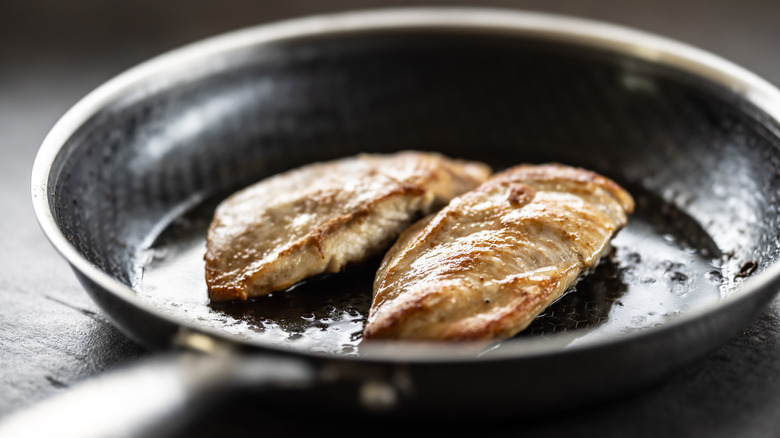
Common kitchen oils are often misunderstood as interchangeable with cooking sprays, but they do not function the same way. One key difference is lecithin, an emulsifier found in many cooking sprays. While lecithin helps keep the spray mixture uniform, it tends to cling to nonstick coatings, making it difficult to remove. Though designed with efficiency in mind, cooking sprays can cause more headache than ease, and especially with nonstick cookware and air fryers, which could be ruined completely. For this reason, this oil alternative is not recommended as a viable option when using nonstick surfaces.
Cooking sprays like PAM are staples in many American kitchens. Both nonstick pans and cooking sprays are marketed for convenience, but consumers are advised not to use them together. Unlike traditional oils, aerosol spray ingredients behave differently under heat, increasing the risk of degrading the nonstick coating. This is because the ingredients common in cooking sprays, aside from oil, have a lower smoke point, which means they burn more quickly than the pan's surface can withstand.
According to user discussions on Reddit, some PAM users noted that the product's smoke point is around 425 to 450 degrees Fahrenheit, which is significantly lower than Teflon's 660 degree-limit. This lower threshold means the spray may burn faster and cause buildup or damage overtime. Repeated exposure can eventually render nonstick pans useless, or in worse cases, hazardous. Instead of risking the negative impact of cooking sprays and high heat nonstick pans sans oil, make sure to grease your pans with some butter or olive oil as a safer, less hassle alternative.