

Meet The Giant Soup Dumpling With A Hidden Heritage
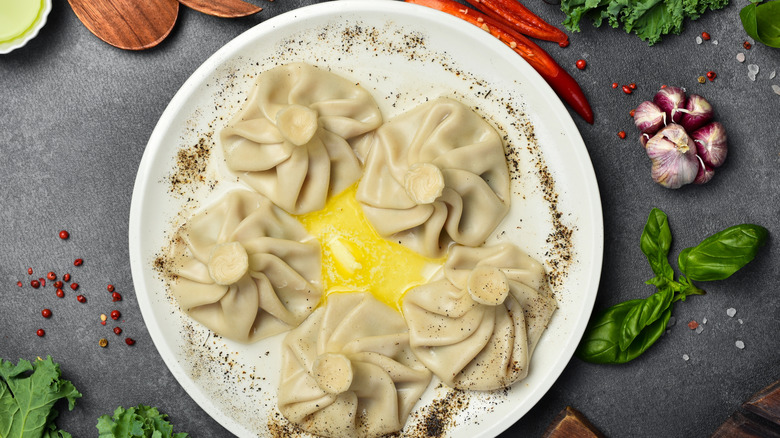
Of all the world's foods, none is quite so beloved, so comforting, and so ubiquitous as the dumpling. From the Japanese gyoza to the Chinese xiao long bao to the hearty wheat dumplings of Central Europe, they're a staple food for much of the world and utterly delicious in all their forms. But one of the truly great recipes comes from a country whose cuisine perhaps doesn't get the love or recognition it truly deserves: Meet the Georgian khinkali.
Georgian food is hearty, meaty, and complex, with a rich history that really sets it apart, and the khinkali is no different. It's a soup dumpling, much like the iconic xiao long bao, but it's much larger — a thick, doughy thing usually filled with spiced meat and broth. While other recipes are made for chopsticks or spoons, khinkalis are made to be picked up by hand, held, and slurped from before you tuck in to the delicious meat inside. They're more rustic than other soup dumplings, with a large, twisted "topknot" called a "kudi," which is discarded once the rest of the dish has been eaten. It's much larger than the xiao long bao, and the filling is usually made of a combination of ground beef and pork (as opposed to the pork gelatin mix that xiao long bao are stuffed with) flavored with herbs and spices like cumin and satureja. But though this is now a beloved national dish of Georgia, it has a long and complicated history, with everything from Mongol invasions to mountain feasts.
The khinkali is a dumpling shaped by conquest (we think!)

We don't know much for certain about the origins of this storied little parcel of deliciousness — its exact beginnings are still debated by food historians. Georgia is a country with a beautiful but challenging landscape, and it was in the northern mountainous regions (like Pshavi and Tusheti) that the khinkali was supposedly born. The most commonly cited theory for the dumpling's invention is that it dates back to the 13th century, when it was likely created as a result of a Mongol invasion. The Mongols (of Ghengis Khan fame) were a nomadic people, and they commonly ate other dumplings like buuz or mantou, which were popular due to their portability and hardiness for long weeks on the road. It's the same type of practical thinking that birthed foods like the Japanese onigiri or British Cornish pasty.
Some historians argue that the khinkali was a homegrown Georgian invention, while others contend that it was actually an adaptation of other dumpling recipes from further east, like the Turkish and Armenian manti or Central and South Asian sambusak and samosa, which likely made their way to Georgia via the Silk Road. Unfortunately, we can't know for sure. Georgian history is often rooted in folklore and the oral tradition, and there are few written records from the time. What we do know is that they were likely influenced by soldiers, who loved the dumplings for their portability and high calorie content — ideal for crossing rugged terrain.
Khinkali is now a national icon, and a modern favorite
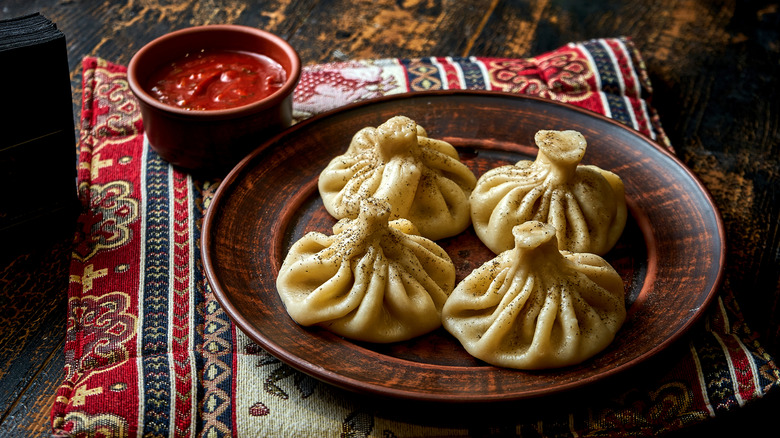
Though often romanticized, the khinkali is a reflection of Georgia's rich history — both of its food and its people. Despite its humble mountain origins, this dumpling is now considered one of the country's most treasured national dishes, a symbol of home, hospitality, and national pride in what is a truly delicious cuisine. It's often served at supra, a traditional Georgian feast where large portions and copious amounts of (very good) wine are commonplace: Georgia is actually responsible for inventing wine, so it makes sense that their food pairs with it particularly well.
Though the traditional dumpling is usually considered to be made with pork and beef, there are a number of regional and international variations that have cropped up in the modern era. Now, you can find them filled with lamb and pork, as well as vegetarian versions stuffed with mushrooms, potatoes, and other veggies. You can also find fusion spins at restaurants around the world, such as miniaturized khinkali or even deep-fried recipes!
Regional differences in preparation mean that there are often variations in the dough's thickness, the spice blends used, and even the ratios of meat to broth. Your average mountain dumpling will probably be different from those you'll find in cities like Tbilisi, for example, but the etiquette remains the same. Just remember: Never use a fork, hold the dumplings by the topknot, and slurp before biting! From a rural soldier's meal to a modern icon, the khinkali is a perfect example of how great food is shaped by history, tradition, and memory.