

How Did Devil's Food Cake Get Its Name?
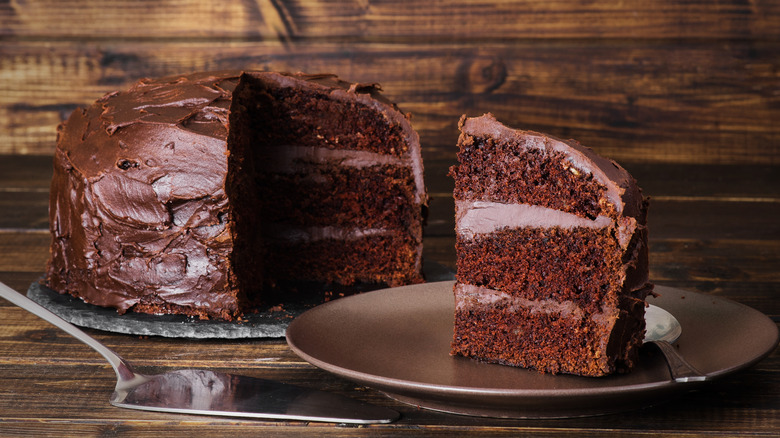
The Devil and food have a long history. We're not talking about the mortal sin of gluttony here, rather the somewhat odd association between Satan and certain dishes, like deviled eggs, deviled ham, and of course, devil's food cake. Ever since the 1700s, the Devil's name has been invoked for dishes that were particularly spicy or heavily seasoned. But, if you've ever enjoyed devil's food cake, while it is super chocolatey, rich, and moist, you know it isn't spicy at all. So how did it end up with a label tied to the Prince of Darkness?
There are several competing theories on how this chocolate cake, which happens to be celebrity chef Alex Guarnaschelli's favorite dessert, got its appellation. The first ties into the use of the Devil not only to describe spicy foods, but dishes that are sinfully rich and decadent. A second theory revolves around the contrast between the richness of the chocolate cake and the light and airy angel food cake. Yet another possibility holds that it was all due to the cake's original color, something closer to a red velvet cake, than the super dark brown version of today. Let's dig a bit deeper into this devilish mystery.
Angel vs Devil or something else?
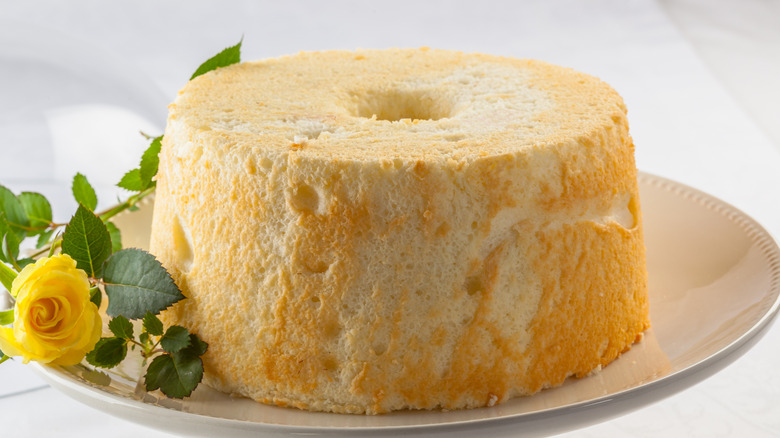
The first time devil's food cake showed up in a cookbook was in "Mrs. Rorer's New Cookbook" from 1902, but probably predates this and likely originated in the U.S. South. At the time, angel food cake was ultra-popular, so it's been theorized that the name came in reaction to these very different cakes. Besides the obvious color differences, the contrast between devil's food and angel food cake comes down, in part, to being two different styles of cake, that is, butter versus foam. Devil's food mostly relies on creamed butter (and egg yolks) for its texture, while angel food uses whipped egg whites and no butter or yolks to achieve its signature airy structure.
The other theory holds that the connection to the Devil is based on the cake's original reddish color, since Satan has often been portrayed as having red skin or wearing red. The early versions of devil's food cake were similar to red velvet due to their ingredients. Unlike today, its reddish hue, as was the color of red velvet, came not from dye but from the chemical reaction between unprocessed cocoa and either buttermilk or vinegar. The color may have been made even redder by the addition of beets that were used to sweeten and add moisture to these types of cakes. However this decadent chocolate cake came to be tied to the Devil, we're happy this sinfully delicious dessert is still around.