

There's More Caffeine In Moka Pot Than You Might Think
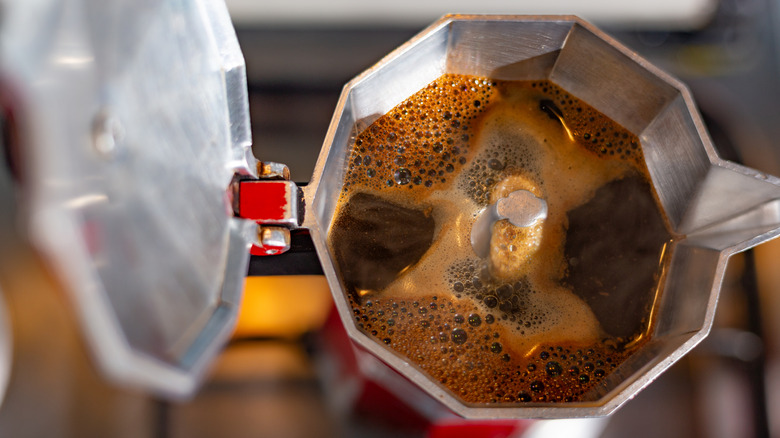
The reality for many of us, even if we drink coffee every day, is that we genuinely don't know how much caffeine we're consuming. The average cup of drip coffee contains 165 milligrams, or about 21 milligrams per ounce, but that can vary based on the type of beans, grind size, and the brewing method. What about the moka pot? This stovetop tool produces strong coffee similar to espresso, and though it is not an espresso machine, it must be stronger than drip coffee, right?
It's true — if you feel a strong buzz after sipping moka pot brewed coffee, it's because the caffeine content is indeed higher than what comes out of a basic coffee machine. Chowhound spoke exclusively to Lena Bakovic, a registered dietitian nutritionist at Top Nutrition Coaching, to understand how moka pot coffee compares to other brewing methods. Bakovic explains, "Coffee made with a moka pot typically has a caffeine content comparable to espresso, tilting it towards the higher end of the caffeine spectrum. Because it uses pressure to push hot water through finely ground coffee, it creates a strong, concentrated brew that contains more caffeine than regular drip coffee and a little less than a traditional espresso shot."
On average, a serving of coffee from the moka pot, which is 2 ounces, contains about 93 mg of caffeine. There are different sizes of moka pots, but one of the popular sizes is called the 6-cup, and it holds 10 ounces of coffee. So, be warned, an entire moka pot of this size is far too much caffeine for one person — but there are tiny moka pots that only produce a single serving if you want to better monitor your caffeine intake.
How to control the amount of caffeine in a moka pot
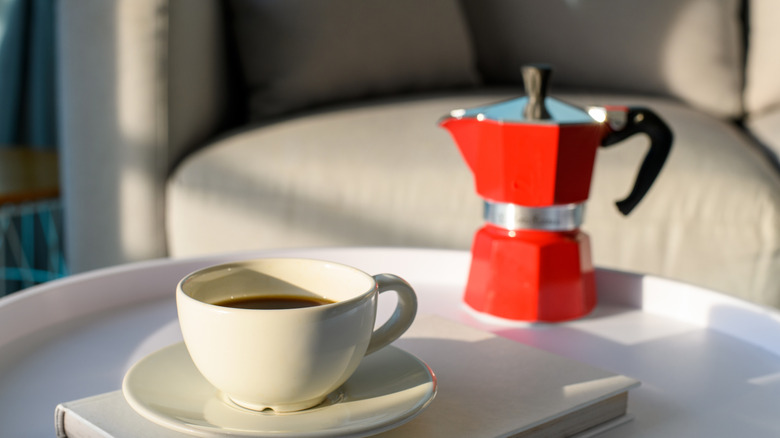
One of the benefits of using a moka pot is that it's easy to use. Second, you can actually control the amount of caffeine in a serving of coffee with a few adjustments. If you understand how the moka pot functions, it's easy to make it just how you like it. As Lena Bakovic explains, "A moka pot operates by heating water in a lower chamber until steam pressure builds up, forcing hot water through a funnel packed with finely ground coffee. This process effectively extracts flavors and caffeine, producing a more concentrated coffee, due to the combination of high pressure and fine grounds."
With that in mind, you can start to tweak how you make a moka pot based on the desired caffeine level. Although it's not possible to know the exact milligram amount of caffeine, Bakovic notes that "the amount of coffee grounds...grind size, brewing duration, finer grinds, and/or a longer brewing time," can all lead to more caffeine extraction. Instead, she suggests that "using fewer grounds or a coarser grind may produce a less caffeinated brew." While it may be tempting to use slightly less coffee for less caffeine, this may not always lend to the most ideal flavor. The basket for coffee is intended to be filled completely, so instead, try using half decaf grinds with half regular coffee.
While moka pot coffee is different than espresso, it can still be used to make a creamy latte or cappuccino. To ensure you get the best flavor from the moka pot, add boiling water instead of room temperature water to the base.