

The Decadent Steak Dish We Don't See At Restaurants Anymore
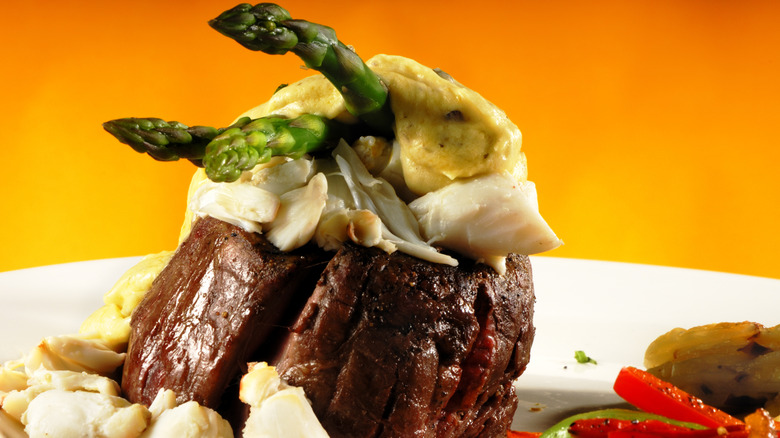
Food trends come and go, and in some cases, it may be for the better when they do make an exit. Tomato soup cake and a few other Depression-era foods come to mind here. However, there are some foods — like the decadent steak Oscar — that deserve to have a resurgence. This combination of pan-seared, tender filet mignon, juicy lump crab meat, creamy béarnaise sauce, and crisp asparagus spears sounds like a winning combination to us.
Once a staple of U.S. steakhouses, steak Oscar has lost some of its prestige and is today often confused with another old school dish, steak Diane (one of crooner Frank Sinatra's favorite foods), but they're actually quite different. Although they typically share the same steak cut and both have a sauce, steak Oscar is basically an ostentatious style of surf and turf while steak Diane is a flambéed dish with a pan sauce and mushrooms.
Steak Oscar is an offshoot of the turn-of-the-century dish veal Oscar, which has a somewhat convoluted history, as is often the case with food. In this instance, the origins, unsurprisingly, revolve around two people named Oscar: Swedish King Oscar II and Oscar Tschirky, known as Oscar of the Waldorf, who was the maître d'hôtel for the famed Manhattan hotel and restaurant.
Steak Oscar is a tasty dish with a confusing history

The history of steak Oscar begins with veal Oscar. The dish has several origin stories, the most popular of which involves the aforementioned Swedish royal, who reigned from 1872 to 1907. Legend says he spent his evenings dining out at Stockholm's Operakällaren restaurant, where they created a signature dish made from the king's three favorite foods — veal, crawfish, and asparagus tips — topped with béarnaise sauce.
Others believe it was Tschirky, a celebrity in his time and inventor of the Waldorf salad (among other dishes), who came up with steak Oscar while overseeing the Waldorf Hotel and later the Waldorf-Astoria from 1893 to 1943. A third version involves the storied Paris eatery Maxim's, where the dish was supposedly created for Tschirky when he came to France for a visit. Whatever the origin, steak Oscar has seen various additions and subtractions over the years, including swapping shrimp for crab and hollandaise for béarnaise sauce.
At some point, most likely during the 1980s, when animal rights campaigners shone a light on the conditions used in growing and processing veal calves, filet mignon came to replace the traditional veal. As the fine dining scene changed to focus on seasonality and lighter dishes, steak Oscar lost some of its shine. Still, there are some restaurants, like Ruth's Chris Steakhouse — the New Orleans-based chain with the confusing name — where you can still get this fabulously tasty, if old school dish.