

How To Use Chiles To Add Flavor Without Adding Too Much Heat
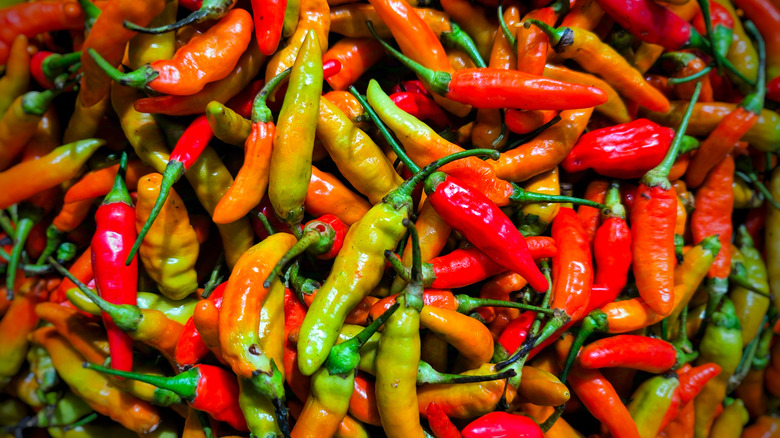
From Thai birds eye peppers to the anchos and pasillas of Mexican cuisine, navigating the world of chiles can be a complex and daunting task. If you get it wrong, you might just get burned! But chiles aren't just about heat; there's a lot of flavor in those peppers, too. Knowing how to extract it without overpowering a dish with spiciness is an important skill. To find out how to use chiles for flavor instead of heat, we spoke to Chef Aom Srisuk of Pomelo and Good Catch restaurants in New Orleans, Louisiana. She started with this classic tip: "My immediate thought here is to take out the seeds and the white membrane of the chili if you want to reduce the heat." So far, so simple. "But [there are] a few other very important ways... to add flavor without an overbearing amount of heat."
One tip is to balance out that spiciness with the addition of fats. For example, there are a great many Thai dishes beloved by locals that haven't found popularity outside of Thailand because the lack of fat makes them overwhelmingly spicy for most Westerners' palates. "Green curry, on the other hand," begins Srisuk, "is still known as one of the spicier curries, but is also one of the most popular curries among both Thais and tourists alike. [That's] because the coconut milk, palm sugar, and fish sauce added into this dish bring the fat, sweetness, and saltiness together with the spicy chile-forward curry base to create a beautifully balanced dish."
How to avoid overwhelming your dish

It can be surprisingly easy to overwhelm a dish with spice, especially depending on who you're serving it to. "First, consider your audience, and their expectations when it comes to taste," Aom Srisuk recommends. "When I cook in the United States... [I] typically use no more than three chiles in a papaya salad (som tum), and that's only when they ask for 'hot.' Meanwhile, in Thailand, it's common to just grab a whole handful [of chiles] — about 10 — and mash them in the mortar and pestle together with the other som tum ingredients. So, the first thing is to match peoples' taste."
Constantly sampling your dish is crucial to ensure you keep things balanced. As Srisuk explains: "It's also important for me to continually taste any recipe as I work through it, but especially when I add chiles into the recipe. Each batch of chiles differs when it comes to how spicy they are, and you can't tell just by looking at them." Balance is key: "Be careful about ensuring a balanced palate — balancing sweet, spicy, salty, and sour... it's important to remember that fat (like coconut milk or oil) and acid (like lime juice or vinegar) will soften the impact of chiles. Those will help to balance the heat." Remember, build heat gradually; "don't forget to start small," Srisuk told us. "You can always add more, but you can't walk back the heat once it's in there!"
How to reduce the heat of a chili

If you're feeling especially cautious — or just want to extract the sweet, smoky flavors of chili peppers without much heat — there are smart ways to reduce their spiciness before cooking. Removing the hottest parts of the pepper is a good start: "The easiest and most common way to do this is to slice into them and remove both the seeds and the white membrane that attaches the seeds to the rest of the chile," Aom Srisuk told us.
But that's not your only option. "By cooking fresh chiles first, you can bring out the natural sugars in the pepper, which brings forward some sweetness that naturally balances the heat." This can create a richer, more balanced flavor aligning with the old chef's adage of "sweet defeats heat." By releasing those sugars through cooking, you mellow the spiciness without adding extra ingredients or diluting the pepper's natural flavor.
Srisuk also suggests going the dry route: "Another way to incorporate chiles into a dish to add flavor without adding too much heat is to use dried or roasted chiles. We do this commonly with Pad Thai." This tamarind-heavy classic, "is typically not served spicy, but it nearly always comes with a side of dried red chile flakes so that a diner can choose their own level of spice." Though drying chiles is usually known to intensify their heat, it offers more precision, letting you control how much spice hits the plate down to the nearest pinch.