

For The Absolute Best Filet Mignon, Follow This Foolproof Technique
We may receive a commission on purchases made from links.
Filet mignon is often called the king of steaks because it's buttery, exceptionally tender, and wonderfully juicy, to the point it practically melts in your mouth. In general, to reach that delicate texture, 400 degrees Fahrenheit is the best temperature to perfectly cook filet mignon in the oven. However, Michael Senich, corporate executive chef and vice president of Longhorn Steakhouse, believes there's no better way to cook filet mignon than searing it on a 425-degree-Fahrenheit flattop grill.
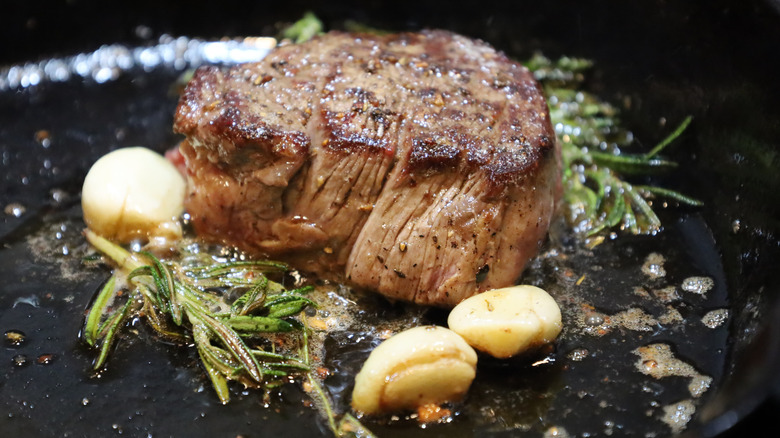
Although recreating that same sear outside a professional kitchen can be tricky, he shared a few tips to help home cooks get close. The first step is to set your stove to medium-high heat and place a cast iron pan on top because cast iron retains heat particularly well and distributes it evenly, which is essential for a good sear. "Pat the top of the steaks dry and apply your favorite seasoning," Senich then told Chowhound in an exclusive talk. "Add a little neutral cooking oil to the pan, and once the oil shimmers, add the steak and cook for three to four minutes per side."
Meanwhile, a good-quality instant-read thermometer, such as the Alpha Grillers Instant Read Meat Thermometer, can make all the difference when it's time to check whether the filet's internal temperature has reached 145 degrees Fahrenheit (as suggested by the U.S. Department of Agriculture). "Always let your steaks rest for at least one to two minutes before cutting into them," said Senich. This ensures the steak stays nice and juicy. "Finally, finish them with a little melted butter or your favorite sauce."
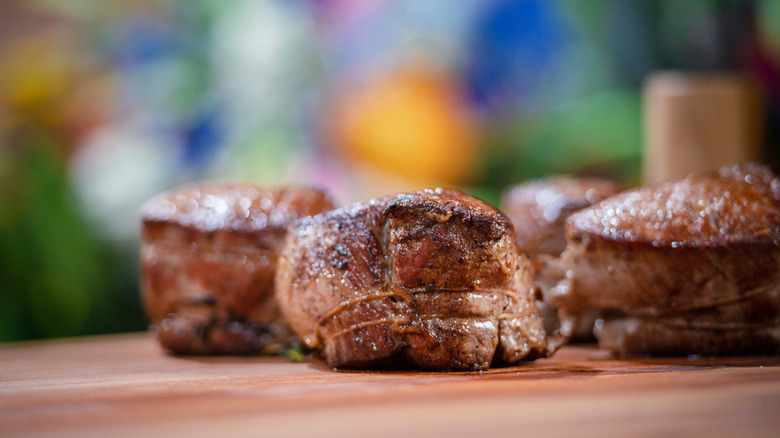
A beautiful crust and juicy center point to a well-cooked filet mignon
Michael Senich shared several more unique benefits of cooking with a cast iron. Apart from their ability to hold onto heat, they're great for the stovetop, the oven, or even the grill. "A quality cast iron pan and an instant-read digital thermometer can help you achieve a steak that's beautifully seared on the outside, juicy on the inside, and cooked exactly to your preferred level of doneness," Senich added.
Meanwhile, for best results, season both sides of the steak evenly. A little salt and some freshly ground black pepper should do the trick. At the same time, choose an oil with a high smoke point (above 400 degrees Fahrenheit) for a nicely browned, uniform crust. If you're wondering what a smoke point is and why it's a big deal, it's the temperature at which an oil starts to break down and develop unpleasant, bitter flavors. It can ultimately ruin the steak's flavor.
To avoid this, Senich proposed using clarified butter, avocado oil, or canola oil. Their smoke points reach up to 480, 520 and 475 degrees Fahrenheit, respectively. Grapeseed oil is another solid choice due to its smoke point of up to 420 degrees Fahrenheit. Refined peanut oil is yet another alternative, with 450 degrees Fahrenheit. Beef tallow (or rendered beef fat) is particularly well suited for searing filet mignon, and has a smoke point of up to 420 degrees Fahrenheit.