

How To Peel Hard-Boiled Eggs Easily Every Time With This Simple Spoon Trick
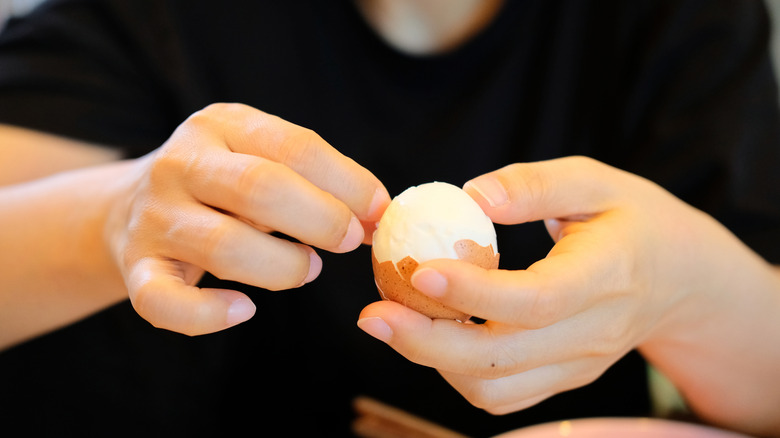
If you're searching for the perfect way to peel hard-boiled eggs, you'll probably find lots of advice. Popular tips might include some hard-boiled egg hacks, such as adding oil or vinegar to the water before boiling, timing suggestions, and peeling techniques. But if you want a method that tackles the source of why peeling an egg can be difficult, try tapping the egg shell lightly to separate the egg shell membrane from the inner shell.
The shell membrane is attached to the contents of the egg as well as the inner part of the shell surface. This makes peeling a hard-boiled egg tricky; the shell can stick to the egg white when you try to remove it, breaking it or creating small (or large) craters. Tapping the wide side of the egg shell very lightly with the rounded center of a spoon before boiling will separate the membrane from the inside of the egg. The trick is to tap lightly enough so as not to break the shell, but solidly enough to make the membrane detach. You may ask how you can tell if and when the membrane separates; when you hear a high pitched snap that's louder than the sound of the spoon tapping the shell, the membrane has detached.
Home cooks might wonder whether you really need to dunk boiled eggs in cold water, as some chefs suggest. It's called shocking, and it makes the egg whites contract, which also pulls the membrane away from the shell. Doing this in combination with tapping the shell can be a really effective pair of techniques for peeling.
Basic egg anatomy and why tapping the egg shell works
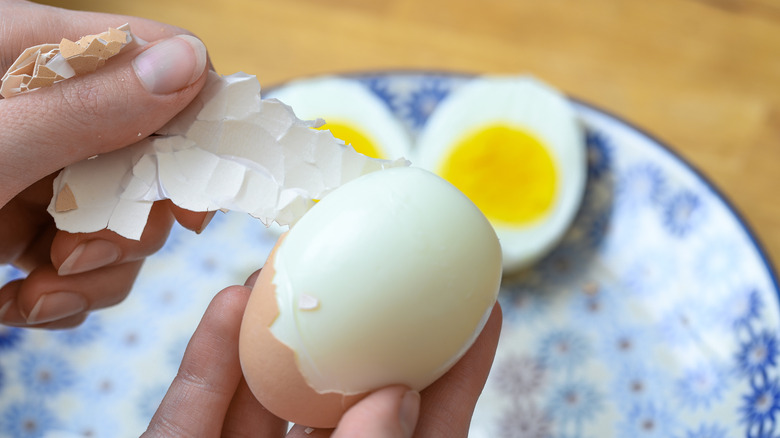
There are actually two membranes in an egg; the inner shell membrane and the outer shell membrane, which are made partly of keratin, a strong material that helps to keep bacteria out of the egg. The white part of the egg is made of protein-rich albumen. The interior albumen is the part that we eat, and the exterior albumen is a narrow layer of fluid that sits next to the shell membrane. There is also a pocket of air between the inner and outer membranes. When you tap the large side of the egg, you crack the shell over this existing air pocket, where the membrane is already less adhered to the shell. This makes peeling it easier and less likely to break some of the pieces of egg white.
There are other techniques that help loosen the membrane, such as boiling slightly less fresh eggs, or letting the eggs come to room temperature before boiling, both of which loosen the membrane. Using baking soda to help peel eggs works on a similar but different principle as tapping. The alkaline nature of baking soda breaks down the proteins in the egg white while boiling them, so the proteins become less strongly bonded to the shell. But, for a quick way to easily make peeling hard-boiled eggs a snap, tapping the egg shell before boiling is a solid method that takes little effort; you just need a good ear and a light touch.